More than half of infectious diseases that have been around for a while, and three quarters of emerging (new) infectious diseases in people are transmitted from other animals to humans. These infections are called zoonoses and cause zoonotic diseases. Zoonoses are defined by the World Health Organization (WHO) as diseases and infections naturally transmitted between people and vertebrate animals.
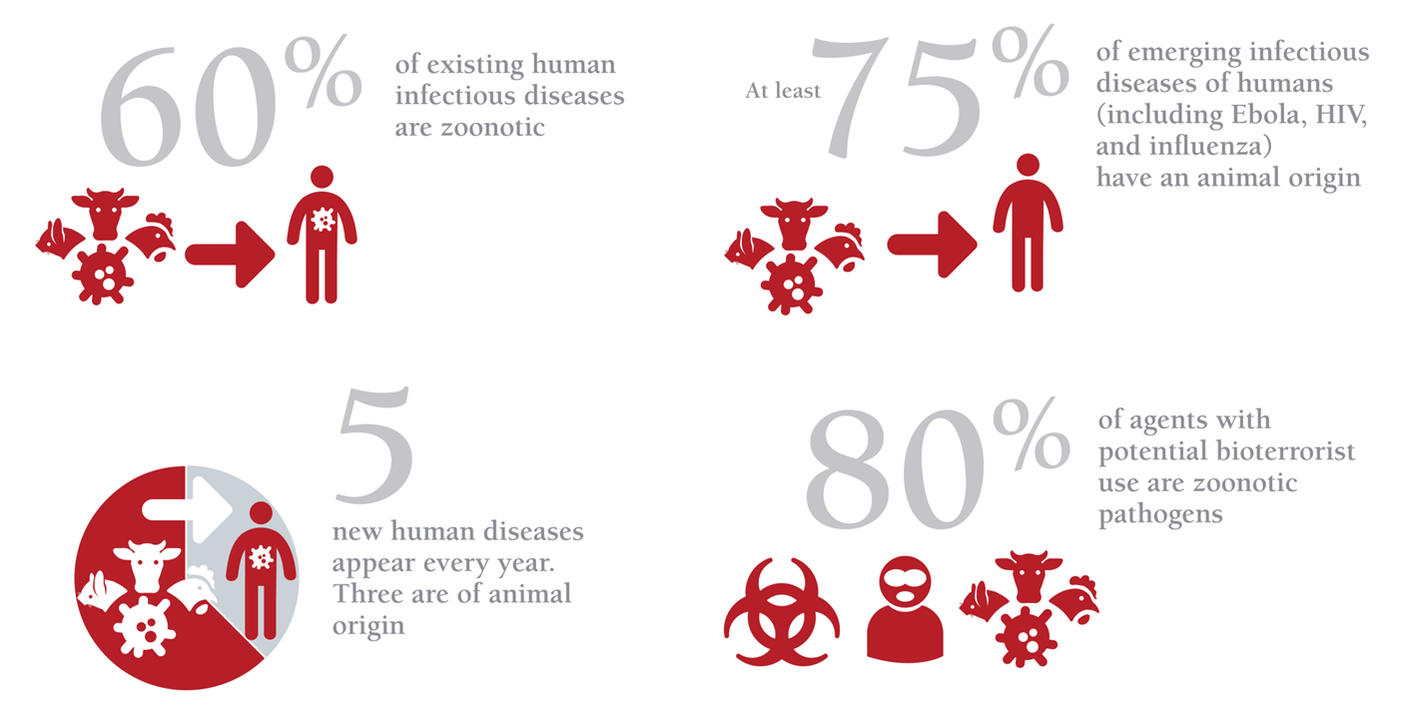
From: OIE (World Organization for Animal Health)
Transmission of these diseases (which are caused by viruses, bacteria, parasites or fungi) can occur in different ways, including direct contact with body fluids from infected animals (by touching pets, or via bites or scratches from them), indirect contact with habitats of or surfaces touched by infected animals (their food containers, aquarium water, plants and soil), vector bites (tick or mosquitoes), or by eating contaminated/undercooked food (milk, meat, eggs, raw fruits and vegetables). An example of direct transmission from animals by bite is rabies transmitted often by dogs. Some zoonoses need an intermediate vector to be transmitted from vertebrate animals to humans, including the bubonic plague (from rats or prairie dogs via fleas to humans, and then between people via respiratory secretions), Lyme disease (from deer mice via ticks) and West Nile virus (from birds, by mosquitoes).
A recent emerging zoonotic disease with a huge impact was SARS (severe acute respiratory syndrome) in 2003, transmitted by a virus and thought to originally come from Chinese horseshoe bats. The virus was then probably transmitted to civets, small cat-like mammals eaten in some parts of China, then “jumping” to humans through exposure by butchering or food preparation. Eventually the SARS virus became capable of being directly transmitted by respiratory secretions between humans. The Middle East respiratory syndrome or MERS virus, although related to the SARS family (coronaviruses), is very different in genetic composition. The MERS virus hosts are camels, however evolutionary ancestors may also have been bats.
The Congo’s Ebola epidemic in West Africa in 2014-2016 was caused by a virus believed to be transmitted by fruit bats that are widespread in many parts of Africa. There is also Ebola virus transmission from monkeys, pigs, forest antelope or porcupines. These wild animals’ meat, some of which is known as bush meat in parts of Africa, is very popular, and its handling by hunters and butchers as well as eating it undercooked pose a great risk for Ebola virus transmission. The virus can also kill gorillas and chimpanzees; gorilla populations suffered an impressive decline of an estimated 5000 gorillas in Gabon and the Republic of the Congo in 2002-2003 during Ebola outbreaks.
A recent emerging zoonotic disease with a huge impact was SARS (severe acute respiratory syndrome) in 2003, transmitted by a virus and thought to originally come from Chinese horseshoe bats. The virus was then probably transmitted to civets, small cat-like mammals eaten in some parts of China, then “jumping” to humans through exposure by butchering or food preparation. Eventually the SARS virus became capable of being directly transmitted by respiratory secretions between humans. The Middle East respiratory syndrome or MERS virus, although related to the SARS family (coronaviruses), is very different in genetic composition. The MERS virus hosts are camels, however evolutionary ancestors may also have been bats.
The Congo’s Ebola epidemic in West Africa in 2014-2016 was caused by a virus believed to be transmitted by fruit bats that are widespread in many parts of Africa. There is also Ebola virus transmission from monkeys, pigs, forest antelope or porcupines. These wild animals’ meat, some of which is known as bush meat in parts of Africa, is very popular, and its handling by hunters and butchers as well as eating it undercooked pose a great risk for Ebola virus transmission. The virus can also kill gorillas and chimpanzees; gorilla populations suffered an impressive decline of an estimated 5000 gorillas in Gabon and the Republic of the Congo in 2002-2003 during Ebola outbreaks.
Human tuberculosis (see my tuberculosis post) is caused by the bacterium Mycobacterium tuberculosis, but bovine tuberculosis caused by Mycobacterium bovis and affecting cattle, can be transmitted to humans in what is known as zoonotic tuberculosis that is sometimes fatal and affects people mostly in Africa and southeast Asia.
Some diseases that are now exclusively transmitted between humans, such as measles, influenza, SARS and HIV, are thought to have jumped at some point from animals to us, and animal domestication may have facilitated some of these events (see my previous post on domestication). Measles may have jumped from dogs to humans, although the measles-causing virus can no longer affect dogs, and smallpox may have originated from a cowpox virus that jumped from cows. The human immunodeficiency virus (HIV) is believed to have originated from chimpanzees and gorillas in Africa, afterwards adapting to the human host transmission. Viruses can change genetically (via mutations) very rapidly, and this favors efficient adaptation to new hosts, to the point where they do not need the previous host for transmission.
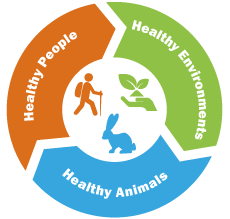
The One Health concept recognizes that humans and animals and their environment/ecosystem are all interconnected. As part of the “One Health” approach, building a strong and effective multi-sectoral collaboration between the animal and human health sectors locally and globally by integrating animal and human disease surveillance and response systems will allow early detection of possible outbreaks and prevent deadly epidemics. Besides zoonoses, the One Health approach also focuses on food safety and antimicrobial resistance (see my post on the latter).
Some diseases that are now exclusively transmitted between humans, such as measles, influenza, SARS and HIV, are thought to have jumped at some point from animals to us, and animal domestication may have facilitated some of these events (see my previous post on domestication). Measles may have jumped from dogs to humans, although the measles-causing virus can no longer affect dogs, and smallpox may have originated from a cowpox virus that jumped from cows. The human immunodeficiency virus (HIV) is believed to have originated from chimpanzees and gorillas in Africa, afterwards adapting to the human host transmission. Viruses can change genetically (via mutations) very rapidly, and this favors efficient adaptation to new hosts, to the point where they do not need the previous host for transmission.
The One Health concept recognizes that humans and animals and their environment/ecosystem are all interconnected. As part of the “One Health” approach, building a strong and effective multi-sectoral collaboration between the animal and human health sectors locally and globally by integrating animal and human disease surveillance and response systems will allow early detection of possible outbreaks and prevent deadly epidemics. Besides zoonoses, the One Health approach also focuses on food safety and antimicrobial resistance (see my post on the latter).

 RSS Feed