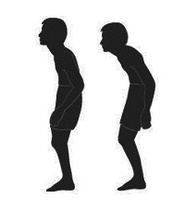
Chikungunya is a virus transmitted by the same daytime-biting mosquitoes that deliver dengue virus into humans, Aedes aegypti and Aedes albopictus, and it also results in similar symptoms compared to dengue, including fever of over 39°C/102°F. Symptoms usually appear 3-7 days after an infected mosquito bites the person. The word “chinkungunya” means "that which bends up” in Makonde language in Tanzania/Mozambique. Because symptoms are similar to dengue, and the virus is often present in the same areas, it is difficult sometimes to diagnose correctly or differentiate between these two viral diseases. Fever, joint pain and skin rash are more common and intense in chikungunya than dengue cases; bleeding is common in dengue hemorrhagic fever as well as a drop in platelets count, and not a symptom of chikungunya. There are no vaccines or specific medicines available for either of these two diseases, only their symptoms are treated with medication. Unlike dengue there is no bleeding in chikungunya. Other symptoms are headache, vomiting, nausea, weakness and muscle pain.
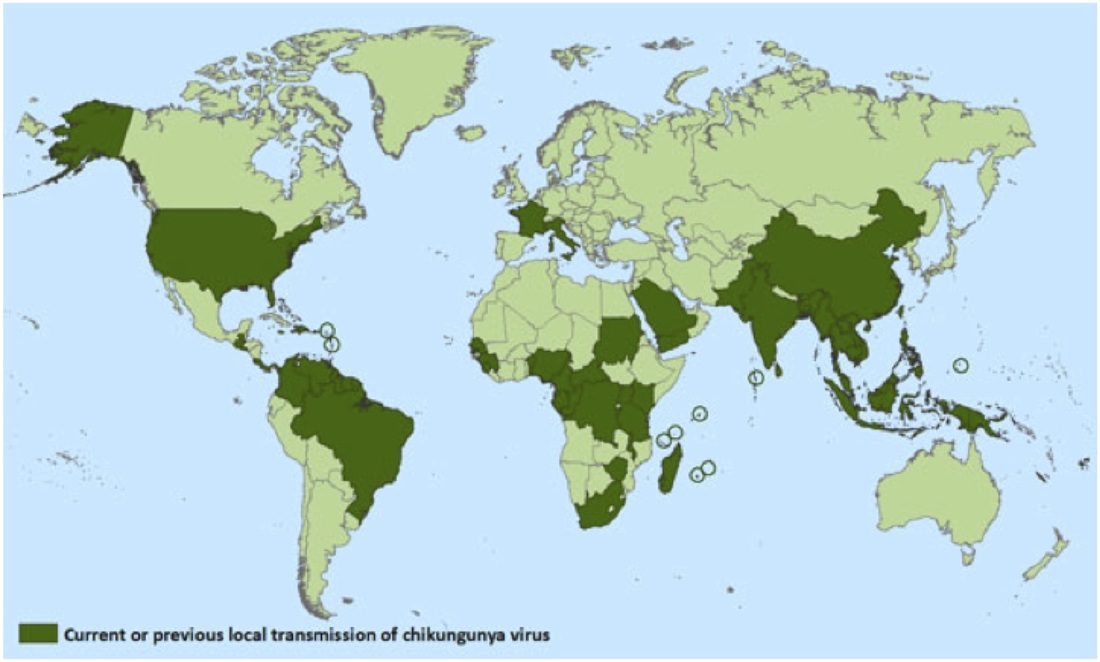
Although this virus has been reported in Africa, Asia and Europe in the past causing outbreaks, the fist reports of cases caused by local transmission (meaning local mosquitoes infected and spreading the virus to humans, as opposed to imported cases by travelers from endemic areas) in the American continent are very recent, just as of December 2013 in the Caribbean. This map from the CDC (available at http://www.cdc.gov/chikungunya/geo/index.html) shows countries and territories where chikungunya local transmission cases have been reported as of September 23, 2014
I currently live in Brazil, where a very interesting strategy is being implemented to combat mosquito transmission of the dengue virus. A team of researchers led by Luciano Moreira infected mosquitoes with an intracellular bacteria called Wolbachia which as a result can not carry the dengue virus. Wolbachia is actually a naturally-occurring bacteria in many insects. The team is planning to release thousands of infected mosquitoes a month for the next four months, the first batch this month in Rio de Janeiro. The hope is that these mosquitoes will reproduce and become the dominant mosquito in Brazil, reducing cases of dengue in humans.
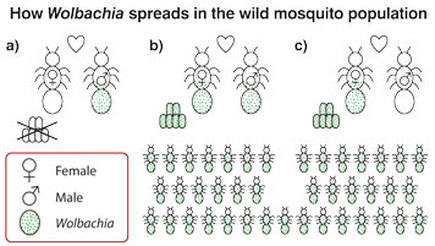
Wolbachia infection in a male mosquito who fertilises the eggs of a female without the bacteria, results in the production of eggs which do not hatch . If both male and female, or only the female mosquito are infected wit Wolbachia, all future generations of mosquito will carry this bacteria. This is illustrated in the figure below from http://www.eliminatedengue.com/our-research/wolbachia. Thus, after a while mosquitoes with Wolbachia become predominant without release of more mosquitoes being necessary.
Some studies show that these Wolbachia-infected mosquitoes also do not carry the chikungunya virus, so this strategy may end up reducing the incidence of both viral fever diseases in Brazil and other places where this Wolbachia-infected mosquito release strategy may be implemented- currently this program is also taking place in Australia, Vietnam and Indonesia.
Wolbachia infection in a male mosquito who fertilises the eggs of a female without the bacteria, results in the production of eggs which do not hatch . If both male and female, or only the female mosquito are infected wit Wolbachia, all future generations of mosquito will carry this bacteria. This is illustrated in the figure below from http://www.eliminatedengue.com/our-research/wolbachia. Thus, after a while mosquitoes with Wolbachia become predominant without release of more mosquitoes being necessary.
Some studies show that these Wolbachia-infected mosquitoes also do not carry the chikungunya virus, so this strategy may end up reducing the incidence of both viral fever diseases in Brazil and other places where this Wolbachia-infected mosquito release strategy may be implemented- currently this program is also taking place in Australia, Vietnam and Indonesia.

 RSS Feed