My Rambling Thoughts
  • Home
  • Blog

WHY YOU SHOULD KNOW ABOUT BIOFILMS

3/14/2013

2 Comments

 
Picture
Bacteria can cause infections inside bigger organisms or live in the environment without causing infection. Either way, it has become apparent only recently that the main form of microbial growth in nature is as biofilms. In the past, in microbiology research different bacteria were usually grown in liquid cultures (or on agar plates) where antibiotic susceptibility was assayed. When grown in liquid medium, bacterial cells are homogeneous in shape, separated from each other and live in a "planktonic" manner. However, most microorganisms exist primarily by attaching to and growing upon other surfaces, both inert and alive which range from plants and soil, water systems and pipes, medical devices including catheters, heart valves and IUDs to animal tissues such as tooth enamel, heart valves, lungs, urogenital surfaces, the middle ear and many others.


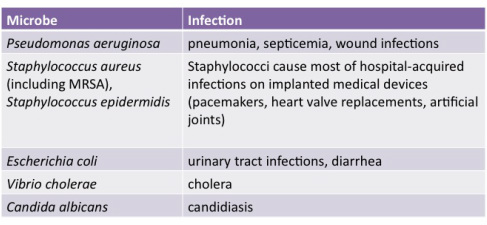
It is estimated in the US that 80% of all microbial infections involve biofilms, which are the main form of growth especially in chronic infections. Below some of the most studied microbes that cause human infections and can grow as biofilms:
Picture
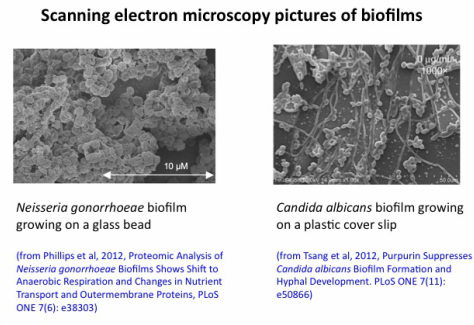
Soon after bacterial (and fungal) biofilm formation began to be studied in research laboratories it became evident that these forms of existence were MUCH more resistant to antibiotics that their equivalents grown in liquid media - sometimes up to 1000 times more amount of antibiotic was needed to result in the same killing or growth inhibition activity in biofilms compared to liquid cultures (these assays as performed in vitro in the lab). This is an important concept because bacteria were classically grown in liquid cultures before and used for  standard antibiotic resistance assays. For more on drug-resistant infections, see my previous blog post on that subject.
Picture
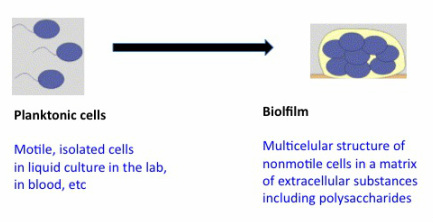
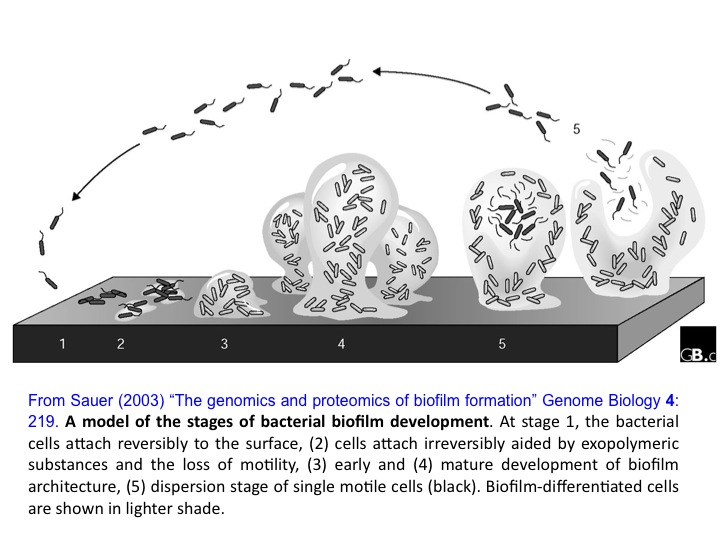
Biofilm formation is a process whereby microorganisms irreversibly attach to and grow on a surface and form a community. The cells that start the process are planktonic, but they undergo transformations both morphologically and in gene expression patterns which result in their growth as a biofilm. They also produce extracellular polymers that facilitate attachment and matrix formation. The biolfilm is a complex semi-multicellular structure which may consist of different types of cells, with internal channels for water and nutrients circulation and some differentiated cells called "persisters" which are dormant cells that survive after most of the biofilm has been destroyed by the action of antibiotics. Most antibiotics base their action on targeting actively growing cells, which persisters are not. Thus, tese cells could be an important target for biofilm-related antibiotic resistance drug development.
Picture
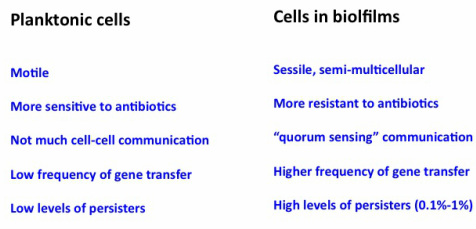
Within  biofilms, cells can communicate and cooperate with each other through "quorum sensing" processes which occur via the secretion of signalling molecules in a population-dependent manner and allow them to sense their proximity. Cells within biofilms are much more densely packed than their planktonic counterparts, a circumstance that has been shown to result in a higher degree of gene transfer between cells. In summary, biofilms are a form of microbial growth very different from and much more complex than planktonic cells from the same species:
Picture
As I write this blog, I realize that pretty much all topics covered so far have boomed in the last 2 decades or so, during which I've been lucky enough to work in labs researching them: histones, epigenetics, telomeres, biofilms ...  As with other recent technological advances, this science research explosion in certain fields is due in part to the development, availability and constant improvement of laboratory techniques and analysis software that allow researchers to further investigate processes that were out of reach before. Without exception though, it has been mainly the use of genetic tools, especially mutants, that has proved the most enlightening when elucidating the mechanisms responsible for the phenomena studied. As research progressed and results became available, these fields have become increasingly relevant to medicine and public health.

For a short 6 min video on description of biofilms and medical relevance by researchers, see: http://youtu.be/lpI4WCM_9pM
2 Comments

TELOMERES, aging AND CANCER

3/7/2013

0 Comments

 
Telomeres, as it happened with histones, were looked at as having more of a structural role as chromosome ends than a more active one in terms of regulating cell aging and cancer. A connection between telomere length and these cellular outcomes has become recently more evident.

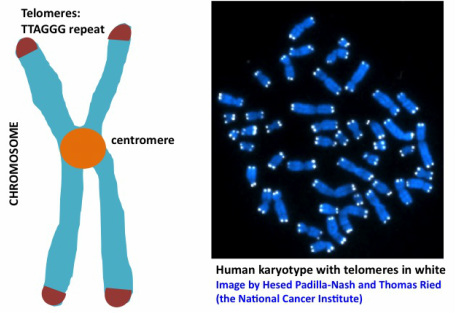
Telomeres refer to the ends of linear chromosomes (from Greek: telos = end, meros = part) consisting of little caps that contain no genes but specific repetitive DNA sequences as shown in the figure below on the left -a hexanucleotide sequence that goes on and on... They can be visualized under the fluorescence microscope by using appropriate staining techniques, shown on the microscopy photo below on the right.
Picture
These chromatin-related fields (histones, telomeres) have grown and attracted attention from other fields such as medicine, and in turn money has become easier to get for labs working on these subjects although the global economy and science research funding situation make it still hard for many researchers to fund their labs. In the early '90s there were general "chromatin" or "nucleus" meetings with a few dozen people attending from the labs working on many different topics, each of them now a huge field on its own. A few years later meetings became more focused, with several hundred people or more attending just for histones (or a specific aspect within the chromatin field) or telomeres. The '90s was also the decade during which the first whole organisms were "sequenced" for the first time. I remember attending the 1994 "yeast meeting" in Seattle where it was announced that a collaborative effort between different labs in the US and Europe was about to yield the whole genome sequence of the budding yeast Saccharomyces cerevisiae. This yeast (my favorite! check my home page) was the first eukaryotic organism to be sequenced- the total amount of DNA was about 12.5 million base pairs of DNA and it took several years. Later on other organisms were sequenced, including other eukaryotes, different bacterial species, mouse and eventually human. The human genome is about 3.3 billion base pairs of DNA and nowadays you can pay money to have your whole individual genome sequenced in a relatively very short time by specialized companies, and due to high competition, the prices are going down. But as usual, I'm diverging from the topic here, which is telomeres...

Telomeres have been shown to be very important in maintaining chromosome integrity. The mechanism by which these last bits of DNA on either chromosome end are replicated and maintained at a certain length is extremely complex, requiring a group of specialized RNA and proteins together to form the enzyme telomerase, responsible for lengthening telomeres. Telomerase was discovered and studied in different organisms for the first time in the '90s. The telomerase complex includes a "reverse transcriptase" enzyme (for details on these enzymes check my previous post on PCR) called TERT for TElomere Reverse Transcriptase.

Because "DNA breaks" are very bad for the cell (these can be induced by chemical agents, UV and other types of radiation, etc) and have to be sensed and repaired by specialized cellular processes and enzymes, telomeres (which are essentially pieces of DNA exposed at the tips of chromosomes) have to be protected by what is called "capping" so they are not "repaired" and sometimes fused with other chromosome ends in an attempt to fix what the cell might wrongly see as a DNA break. There are proteins bound to telomeres that block access to them, called "shelterins" during times of the cell cycle in which they might be seen as broken chromosomes.

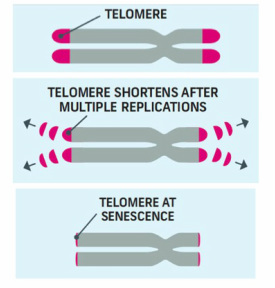
Because of the way telomere replication occurs, they get shorter and shorter with each cell division, until they reach a critical shortness resulting in chromosome instability, cell senescence and eventually cell death. This mechanism is sometimes referred to as a cellular "clock" that regulates how many times a cell should divide before dying.
Picture
Modified from the NIA/NIH at URL: http://www.nia.nih.gov/health/publication/genetics-aging-our-genes/what-happens-when-dna-becomes-damaged

In several organisms where the correlation between cell age and telomere length has been evaluated, it has been shown that in general older cells have shorter telomeres, although this is not the case in every species or in all tissues from the same organism. One problem with these observations is that in general the way telomere length is analyzed involves extracting DNA containing telomeres from a lot of cells, therefore the measurement is an average length from the whole population. As shown in the figure below, in old individuals the accumulation of a proportion of senescent cells with critically short telomeres compromise tissue function and regeneration, contributing to aging and associated diseases. A better indicator is the measurement of the proportion of cells with very short telomeres in a population rather than the average telomere length of the same population.
Picture
Figure modified from the review by Vera and Blasco (2012) “Beyond average: potential for measurement of short telomeres”, Aging, 4:379-392

Aging of course is a topic that everyone is interested in, especially when anti-aging possibilities arise. When telomere length and telomerase were studied further, some commercial products appeared in the market such as  supplements and anti-aging creams claiming development of new formulas containing agents that could sow down aging based on counteracting the short telomeres effect or providing telomerase, such as a $1,500 skin cream (http://tmagazine.blogs.nytimes.com/2010/04/22/miracle-worker/).

In 2009, the Nobel Prize in Physiology or Medicine went to Elizabeth Blackburn, Carol Greider and Jack Szostak for their studies on telomeres. A short interview with Elizabeth Blackburn on new and exciting applied research on telomeres if found at:
http://www.scientificamerican.com/article.cfm?id=blackburn-elizabeth-telomeres-anecdotes-from-nobel-prize-winner

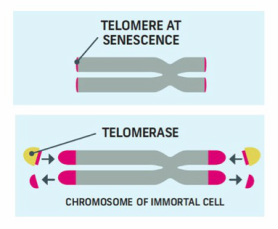
A malignant, cancer cell which divides in an unregulated manner, usually has levels of telomerase activity higher than equivalent cells form the same tissue which are not malignant (these cells in fact have low or no detectable levels of telomerase unless they are stem or progenitor cells). This has been shown to be the case not for early forms of cancer but more advanced ones; telomerase can be detected in approximately 90% of all malignant tumors which makes it a highly attractive therapeutic target. These cells are thought to activate telomerase to lengthen the otherwise critically short telomeres which would induce senescence and death. The presence of active telomerase confers the immortality intrinsic to cancer cells which can divide uncontrollably.
Picture
Modified from the NIA/NIH at URL: http://www.nia.nih.gov/health/publication/genetics-aging-our-genes/what-happens-when-dna-becomes-damaged

Whenever researchers find something that makes cancer cells be what they are, the immediate reaction is to look for ways to eliminate or inhibit this something. For example if it is a protein or enzyme such as telomerase, one can "screen" for inhibitors in vitro in the lab first, then move on to animal models and eventually test a possible cancer therapy in humans in clinical trials. However, there is a 10% of cancers which can extend telomeres by using a telomerase-independent mechanism for which this treatment would not work, and of course there is the concern that the target is actually an enzyme that should be active in stem cells in non-cancerous tissues.

As a final remark, just to emphasize how much better it seems for us to have longer rather than short telomeres, numerous studies that have looked at people with different conditions have found that, besides aging and cancer, short telomeres seem to be associated with the following:

* earlier death (Denmark)
* short sleep duration
* phobias, anxiety, depression, stress, schizophrenia
* childhood chronic or serious illness (Finland)
* several diseases

However, as with all correlations found in clinical research, we have to be very cautious when interpreting these, as they don't necessarily indicate a CAUSAL relationship in one particular direction. All these conditions might affect the way our cells divide and replicate their DNA, resulting in more DNA damage accumulated with time, and therefore shorter telomeres could be a downstream effect.
0 Comments

PUBLISHING RESEARCH FROM LESS DEVELOPED COUNTRIES 

3/4/2013

2 Comments

 
I have worked in science research in both developed and underdeveloped countries. The type of research, infrastructure, resources and money vary greatly between both settings in the expected direction (more of everything in developed settings) but there are fields that have proven productive and successful in less developed countries. These countries tend to be located in tropical settings, and as a consequence one big area of research is tropical diseases such as malaria, dengue, and Chagas disease and others not specifically tropical but with huge numbers of people affected in the tropical areas such as tuberculosis. The access to high numbers of patients, insect vectors that transmit the disease to humans, and often easier and less regulated conditions to work with the infectious agents (biosafety levels 1/2 for tuberculosis for example in underdeveloped labs as opposed to level 3 in more regulated places such as the US or European labs) allow local labs in less developed tropical countries to conduct great research due in part to the abundance of samples. As a consequence, collaborations are established between labs in developed and underdeveloped countries by which samples isolated from patients or insects in less developed areas are sent to developed countries laboratories which can perform more sophisticated analytical assays, animal model experiments (see previous blog entry on this subject if you are interested) and other research that requires more resources. Expensive reagents that come from developed settings' manufacturers are even more expensive when ordered from tropical settings (as there is additional cost for shipping) and these might get stuck at customs and other places before final delivery where they might not be kept at the required low temperature (on ice or dry ice) and therefore lose

Publication of this type of research from less developed settings becomes a tricky issue though. I have experienced first hand how some potentially clinically relevant research can go unpublished when conducted in less developed countries. There are a few factors associated with this reality, which are beginning to be addressed by the global scientific community:

1) One very important determinant of whether important research gets published or not in a high access journal is the very high fees that are required to publish peer reviewed manuscripts in some cases (especially relative to exchange rates and local cost of living in non-USdollar/GBP/Euro economies). This fee goes entirely to the journals (not to the reviewers, which are researchers asked to volunteer for this purpose) and varies depending on the journal status, type of manuscript, number of color figures etc.

2) The time that requires to write a manuscript is another factor to consider when people spend much of the time on the actual research or teaching in research/teaching universities. There is a pressure to publish in some underdeveloped places, but not as high as in developed countries where publishing is required to get promoted and get tenured and grants. The work might get presented in local meetings, or published in local journals which do not have high exposure or be in English language, and usually the results never make it to potentially interested parties in developing diagnostic or treatment kits such as pharmaceutical companies.

3) The language: tropical settings in Latin America, Asia and some places in Africa (francophone countries) would not often present or write their results in English at local meetings. This makes the possible manuscript writing process take much longer and be much more painful for researchers in these areas.

4) In terms of access to information, money is a big factor that restricts journals and publications that underdeveloped settings have access to as they might not have the subscriptions that developed countries' research institutions usually have .... this is in addition to limited internet access, downloading speed and services, and printing capabilities.

Newer journals such as PLOS have surged recently that not only publish high quality peer-reviewed research (valued as such by the scientific community) but are working on 2 important directions to make research more widely available for those interested in reading about it: 1) they are "open access", which means anyone can look at and download any publication (without paying any fees or having to subscribe to the journal) and more importantly for underdeveloped settings' research authors: 2) they have the option to apply for waved or lower fees for publication depending on the country submitting the work, specifically in their "PLOS neglected tropical diseases" (check out link for info for authors in developing countries: http://www.plosntds.org/static/developing;jsessionid=A3E5334790DDEA736A6EA113AF80CEB6).

Open access journals might not be aware of this, but as I writer of reviews on specific research subjects, I look for images to include in our publications (and for this blog!) to use as such or to modify depending on the context, and preferentially use the ones from open access journals without infringing copyright issues - when you want to use materials from other journals, books and websites you usually have to request permission from the publisher, including often paying fees. PLOS and other open access journals only ask that you cite the source, and the authors who publish there agree to these terms.

NOTE: I have no connection with PLOS, and all the statements made here about publishing research from developed versus less developed countries are generalizations (which, as with all generalizations, come with exceptions).
2 Comments
    Picture

    Author

    Hi! This is an attempt to write simply about things I feel passionate about. My name is Judith Recht and I am a scientist by training, a later-in-life mother, and an expat in Bangkok, Thailand and Recife, Brazil (~4 years in each country) now back in the US. I was born in one country (USA) grew up in another (Venezuela) raised by Argentine parents and moved around four more times (NYC to Bangkok to Recife to Maryland). This blog is for those of you who might be interested in the diverse topics so far included and others coming up soon.

    Archives

    July 2021
    April 2021
    January 2021
    October 2020
    March 2020
    December 2019
    November 2019
    September 2019
    June 2019
    March 2019
    January 2019
    November 2017
    October 2017
    September 2017
    June 2017
    April 2017
    February 2017
    November 2016
    October 2016
    June 2016
    May 2016
    January 2016
    December 2015
    November 2015
    September 2015
    April 2015
    March 2015
    October 2014
    September 2014
    July 2014
    May 2014
    April 2014
    February 2014
    September 2013
    March 2013
    February 2013
    January 2013

    Categories

    All

    RSS Feed

Proudly powered by Weebly