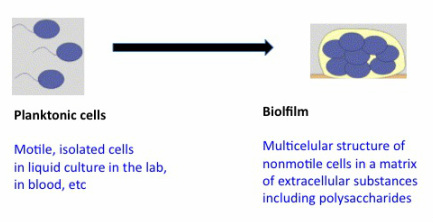
Bacteria can cause infections inside bigger organisms or live in the environment without causing infection. Either way, it has become apparent only recently that the main form of microbial growth in nature is as biofilms. In the past, in microbiology research different bacteria were usually grown in liquid cultures (or on agar plates) where antibiotic susceptibility was assayed. When grown in liquid medium, bacterial cells are homogeneous in shape, separated from each other and live in a "planktonic" manner. However, most microorganisms exist primarily by attaching to and growing upon other surfaces, both inert and alive which range from plants and soil, water systems and pipes, medical devices including catheters, heart valves and IUDs to animal tissues such as tooth enamel, heart valves, lungs, urogenital surfaces, the middle ear and many others.
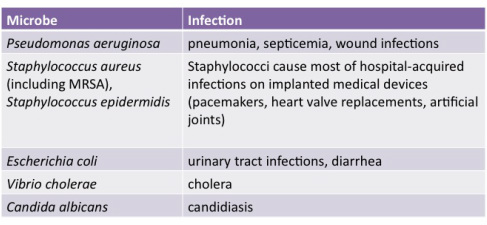
It is estimated in the US that 80% of all microbial infections involve biofilms, which are the main form of growth especially in chronic infections. Below some of the most studied microbes that cause human infections and can grow as biofilms:
It is estimated in the US that 80% of all microbial infections involve biofilms, which are the main form of growth especially in chronic infections. Below some of the most studied microbes that cause human infections and can grow as biofilms:
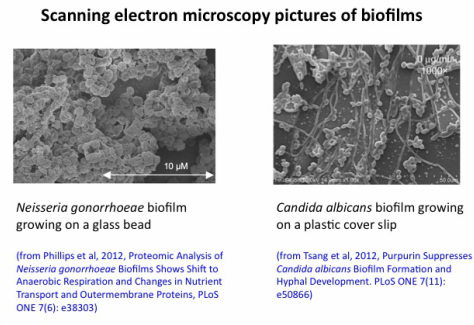
Soon after bacterial (and fungal) biofilm formation began to be studied in research laboratories it became evident that these forms of existence were MUCH more resistant to antibiotics that their equivalents grown in liquid media - sometimes up to 1000 times more amount of antibiotic was needed to result in the same killing or growth inhibition activity in biofilms compared to liquid cultures (these assays as performed in vitro in the lab). This is an important concept because bacteria were classically grown in liquid cultures before and used for standard antibiotic resistance assays. For more on drug-resistant infections, see my previous blog post on that subject.
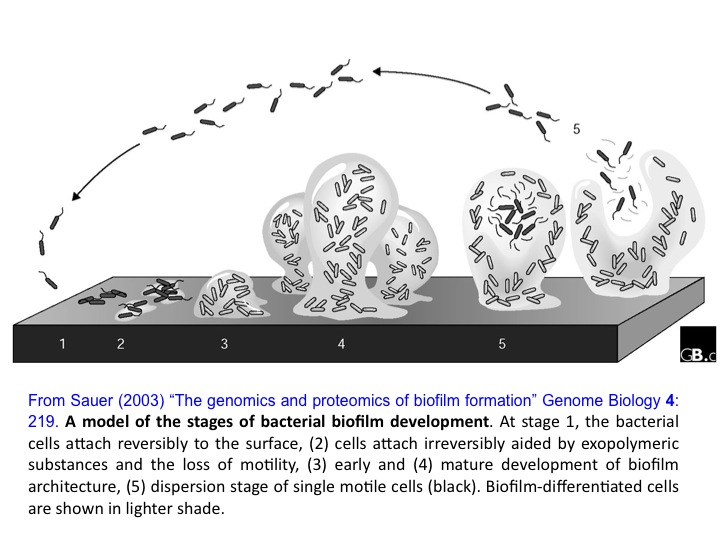
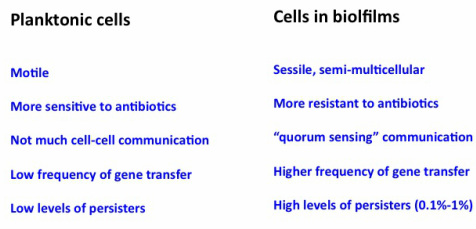
Biofilm formation is a process whereby microorganisms irreversibly attach to and grow on a surface and form a community. The cells that start the process are planktonic, but they undergo transformations both morphologically and in gene expression patterns which result in their growth as a biofilm. They also produce extracellular polymers that facilitate attachment and matrix formation. The biolfilm is a complex semi-multicellular structure which may consist of different types of cells, with internal channels for water and nutrients circulation and some differentiated cells called "persisters" which are dormant cells that survive after most of the biofilm has been destroyed by the action of antibiotics. Most antibiotics base their action on targeting actively growing cells, which persisters are not. Thus, tese cells could be an important target for biofilm-related antibiotic resistance drug development.
Within biofilms, cells can communicate and cooperate with each other through "quorum sensing" processes which occur via the secretion of signalling molecules in a population-dependent manner and allow them to sense their proximity. Cells within biofilms are much more densely packed than their planktonic counterparts, a circumstance that has been shown to result in a higher degree of gene transfer between cells. In summary, biofilms are a form of microbial growth very different from and much more complex than planktonic cells from the same species:
As I write this blog, I realize that pretty much all topics covered so far have boomed in the last 2 decades or so, during which I've been lucky enough to work in labs researching them: histones, epigenetics, telomeres, biofilms ... As with other recent technological advances, this science research explosion in certain fields is due in part to the development, availability and constant improvement of laboratory techniques and analysis software that allow researchers to further investigate processes that were out of reach before. Without exception though, it has been mainly the use of genetic tools, especially mutants, that has proved the most enlightening when elucidating the mechanisms responsible for the phenomena studied. As research progressed and results became available, these fields have become increasingly relevant to medicine and public health.
For a short 6 min video on description of biofilms and medical relevance by researchers, see: http://youtu.be/lpI4WCM_9pM
For a short 6 min video on description of biofilms and medical relevance by researchers, see: http://youtu.be/lpI4WCM_9pM

 RSS Feed