In many scientific disciplines some research questions require data collection efforts far beyond those realistically possible with available technologies and funding, including surveys spanning long periods of time or large geographies, or unrealistic computing capacity. Early approaches to tackling these questions involved the first organized public participation projects such as the North American Breeding Bird Survey established in 1966, where thousands of people in the USA and Canada collect data on birds during their breeding season. Organizing large numbers of people to help collect data or do computational tasks, such as identifying objects in images or sounds, require substantial organizational and communication efforts. Seeking answers to those once thought of as “difficult questions” changed significantly with the advent of the internet, which facilitated communication and data gathering as well as resources organization and availability. For example, SETI (Search for Extraterrestrial Intelligence, famous after the movie Contact) asks for people’s help by donating their computer’s down time to process large amounts of data. This revolution spurred by the internet was not just in scientific disciplines; outside of science, instant access to online news and social networks has led to amazing contributions from people all over the world, as in news outlets accepting (and even requesting) photos and videos from contributors where developments are being reported in real time.
The growing cool trend in science involving active non-professional public participation in knowledge gathering, is variously called citizen/community/crowd/volunteers science and features prominently in a wide variety of science and research areas.
The growing cool trend in science involving active non-professional public participation in knowledge gathering, is variously called citizen/community/crowd/volunteers science and features prominently in a wide variety of science and research areas.
Are you a bird watcher or an amateur astronomer? You could contribute to global science knowledge by adding your local observations to global online platforms already available and free to anybody for a variety of topics such as these, or just explore them and find out what others are contributing and what the analyses of the data show. At “project finder” from Scistarter, you can find thousands of citizen science projects. Citizen science projects with popular online platforms have led to important peer-reviewed publications in science journals, which should be open access; a study published in 2020 showed that from all science papers that included citizen science activities, half were in ecology, environmental sciences and biodiversity.
Citizen science participation is not limited to environmental research. You can help in projects as divergent as microbiology or sociology. Sometimes the research is serendipitous and with no app or platform involved, as was the case with the accidental loss of 29,000 rubber ducks from containers on a ship to the USA from China in 1992. With the help of people from all over the world, 10 years later scientists had data on how far and how long it took for the little rubber ducks to wash ashore and used these data to discern the size and speed of ocean currents around the place of the spill.
What is or isn’t citizen science is often not clearly defined, in fact there is no agreement on a globally accepted definition. Sometimes projects that gather information from volunteers submitting it online are labelled as citizen science, when these volunteers are not really doing the work of scientists but just sending their own data. These studies are no different from studies that request participation from volunteers as study subjects, except that the advertisement and data collection are done through web tools. An example of a recent project wrongly referred to by some as citizen science was one used early in the COVID-19 pandemic known as the Covid Symptom Tracker, a collaboration between US and UK scientists and doctors, and Zoe, a healthcare company, consisting of a free symptom tracker smartphone application launched in March 2020 in both countries. A Nature Medicine paper published in May 2020 showed and discussed results from 2,618,862 participants in a study using this application to report potential COVID-19 symptoms. The main finding was the loss of smell and taste as COVID-19 symptoms, and therefore authors recommended to add these to the list of symptoms that back then did not include them. These symptoms are now well known to be associated with the disease, and are frequently listed as such.
Citizen science involves non-professional scientists (lay people) with several possible roles, depending on the project, ranging from developing the research question and designing the method to contributing data, checking or monitoring, interpreting and analyzing data. Citizen science allows collection of data from widespread geographic areas over long periods of time, and promotes collaboration and interaction between scientists and citizens while at the same time resulting in a more informed, involved and engaged public.
Examples of popular and successful projects that have collected data via citizen science are:
1) eBird: a growing platform with bird sightings contributed by bird watchers around the world with many partner organizations and regional experts and managed by the Cornell Lab of Ornithology. It is available worldwide as a free mobile app that collection of data offline, and a website to explore and summarize global eBird data.
2) Foldit: A “protein folding” web-based game launched in May 2008 for players to use the mouse to provide shapes for specific proteins was compared to the Rosetta algorithm developed by scientists with the same purpose. Player strategies ended up outperforming Rosetta algorithms, with a PNAS publication of these impressive results that included “Foldit players” as co-authors.
3) Polymath: several math platforms for different topics (Banach spaces, Polynomial Hirsh Conjecture, Bounded gaps between primes, etc) developed as collaborations among professional and amateur mathematicians to solve problems based on online communication.
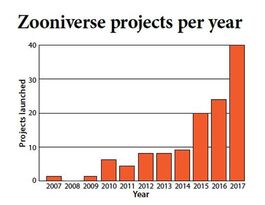
4) Zooniverse platform (este va con el gráfico de abajo on the side): Launched in 2007 with one project (Galaxy Zoo), Zooniverse has grown exponentially to 74 projects active now, 195 others paused, and 56 finished, covering a range of topics in biology, history, climate science, the arts, medicine, ecology, and social sciences. This incredibly diverse and successful platform offers current projects that you can browse and learn about including Galaxy Zoo, Chimp&See, Penguin Watch, Etch a cell, and many others.
When a project requires the collection and interpretation of data by the community of volunteers, one of the most pressing criticisms is about data quality. In these situations, data collection and interpretation are subjected to biases that may introduce error in the data and could lead to erroneous conclusions. This is because, as opposed to “controlled” experiments in which scientists standardize all aspects of data collection, citizen scientists inevitably have a variety of skill levels, knowledge, interest, and experience. For example, when asked to count objects in an image, some people may count more or fewer than others due to different levels of involvement, attention to details, etc.
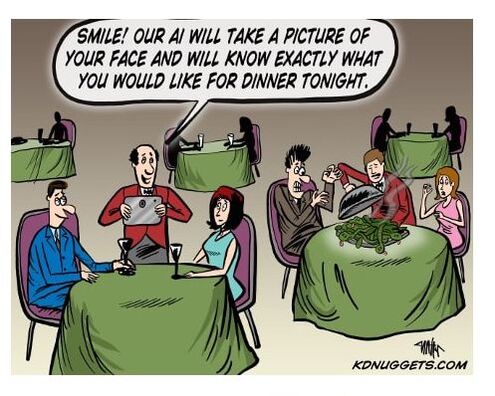
Another fantastic trend in science in the past decade is the robotization of data collection and processing. We are far from being able to deploy drones or autonomous data collection devices in large amounts to survey vast areas, or to set them in place to survey for long periods of time. Similarly, our computing power, artificial intelligence and machine learning have advanced immensely in recent years but using computers to process data at the speed and with the accuracy of the human brain remains a glimmer in the horizon. In the meantime, citizen science will grow and become an important methodological approach to tackle the “difficult questions”. Furthermore, with that future robotization goal in mind, some citizen science projects use the help of volunteers to train computers, such as Soundscapes to Landscapes, where volunteers generate the data to feed artificial intelligence models in order to identify bird species in sound recordings. Perhaps in the next few decades we will see the development in many disciplines of means for lay people to train computers that then help scientists answer increasingly difficult and complex questions.
What is or isn’t citizen science is often not clearly defined, in fact there is no agreement on a globally accepted definition. Sometimes projects that gather information from volunteers submitting it online are labelled as citizen science, when these volunteers are not really doing the work of scientists but just sending their own data. These studies are no different from studies that request participation from volunteers as study subjects, except that the advertisement and data collection are done through web tools. An example of a recent project wrongly referred to by some as citizen science was one used early in the COVID-19 pandemic known as the Covid Symptom Tracker, a collaboration between US and UK scientists and doctors, and Zoe, a healthcare company, consisting of a free symptom tracker smartphone application launched in March 2020 in both countries. A Nature Medicine paper published in May 2020 showed and discussed results from 2,618,862 participants in a study using this application to report potential COVID-19 symptoms. The main finding was the loss of smell and taste as COVID-19 symptoms, and therefore authors recommended to add these to the list of symptoms that back then did not include them. These symptoms are now well known to be associated with the disease, and are frequently listed as such.
Citizen science involves non-professional scientists (lay people) with several possible roles, depending on the project, ranging from developing the research question and designing the method to contributing data, checking or monitoring, interpreting and analyzing data. Citizen science allows collection of data from widespread geographic areas over long periods of time, and promotes collaboration and interaction between scientists and citizens while at the same time resulting in a more informed, involved and engaged public.
Examples of popular and successful projects that have collected data via citizen science are:
1) eBird: a growing platform with bird sightings contributed by bird watchers around the world with many partner organizations and regional experts and managed by the Cornell Lab of Ornithology. It is available worldwide as a free mobile app that collection of data offline, and a website to explore and summarize global eBird data.
2) Foldit: A “protein folding” web-based game launched in May 2008 for players to use the mouse to provide shapes for specific proteins was compared to the Rosetta algorithm developed by scientists with the same purpose. Player strategies ended up outperforming Rosetta algorithms, with a PNAS publication of these impressive results that included “Foldit players” as co-authors.
3) Polymath: several math platforms for different topics (Banach spaces, Polynomial Hirsh Conjecture, Bounded gaps between primes, etc) developed as collaborations among professional and amateur mathematicians to solve problems based on online communication.
4) Zooniverse platform (este va con el gráfico de abajo on the side): Launched in 2007 with one project (Galaxy Zoo), Zooniverse has grown exponentially to 74 projects active now, 195 others paused, and 56 finished, covering a range of topics in biology, history, climate science, the arts, medicine, ecology, and social sciences. This incredibly diverse and successful platform offers current projects that you can browse and learn about including Galaxy Zoo, Chimp&See, Penguin Watch, Etch a cell, and many others.
When a project requires the collection and interpretation of data by the community of volunteers, one of the most pressing criticisms is about data quality. In these situations, data collection and interpretation are subjected to biases that may introduce error in the data and could lead to erroneous conclusions. This is because, as opposed to “controlled” experiments in which scientists standardize all aspects of data collection, citizen scientists inevitably have a variety of skill levels, knowledge, interest, and experience. For example, when asked to count objects in an image, some people may count more or fewer than others due to different levels of involvement, attention to details, etc.
Another fantastic trend in science in the past decade is the robotization of data collection and processing. We are far from being able to deploy drones or autonomous data collection devices in large amounts to survey vast areas, or to set them in place to survey for long periods of time. Similarly, our computing power, artificial intelligence and machine learning have advanced immensely in recent years but using computers to process data at the speed and with the accuracy of the human brain remains a glimmer in the horizon. In the meantime, citizen science will grow and become an important methodological approach to tackle the “difficult questions”. Furthermore, with that future robotization goal in mind, some citizen science projects use the help of volunteers to train computers, such as Soundscapes to Landscapes, where volunteers generate the data to feed artificial intelligence models in order to identify bird species in sound recordings. Perhaps in the next few decades we will see the development in many disciplines of means for lay people to train computers that then help scientists answer increasingly difficult and complex questions.
Cartoon drawn by Jon Carter

 RSS Feed