I have always been a bit shocked at how many people (and I'm not referring to very young ones in particular!) are unaware of their blood type, especially in the US.
Knowing your blood type, and that of your relatives, and especially your partner's and children's is very important not only in case of emergencies for which blood transfusions are needed, but also, as it was my case, to prevent a maternal reaction from an Rh- mother such as myself towards an Rh+ fetus.
Before blood types were known, when blood was supposed to be the same for everybody, fatal blood transfusions occurred. The Austrian biologist and physician Karl Landsteiner discovered the ABO human blood groups in 1901 and proposed their classification and transfusion-compatible groups, all this the body of work for which he received in 1930 the Nobel Prize in Physiology or Medicine. Later on his work with Alexander Wiener led to the identification of the Rhesus (Rh) factor in 1937 which was first discovered in Rhesus monkeys, where the name comes from.
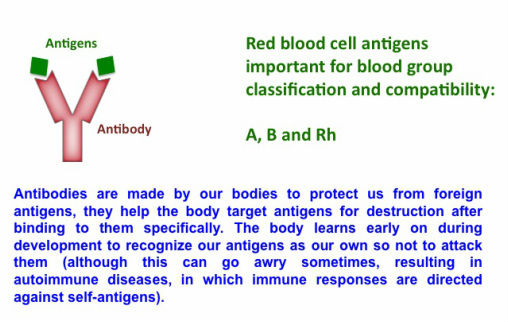
Red blood cells (RBCs), the blood component which transports oxygen and gives blood its red color (as opposed to white blood cells which are also in blood and are an important part of the immune system that fights infection) also carry "antigens" on their cell surface, exposed towards the outside of the cell and facing the liquid (plasma) in which "antibodies" may be found. Specific antigens are bound by specific antibodies. The latter are usually made by our bodies in response to a "foreign" substance (viruses and bacteria are good examples) and by binding to them at specific spots (antigenic) they can signal and trigger an immune response in which complex mechanisms bring about specialized cells that can "clean up" our bodies from infectious agents. The antigens present on the surface of our RBCs that determine our blood type are: A and B antigens (from the ABO group, group O has no antigens present) and the Rh factor.
Knowing your blood type, and that of your relatives, and especially your partner's and children's is very important not only in case of emergencies for which blood transfusions are needed, but also, as it was my case, to prevent a maternal reaction from an Rh- mother such as myself towards an Rh+ fetus.
Before blood types were known, when blood was supposed to be the same for everybody, fatal blood transfusions occurred. The Austrian biologist and physician Karl Landsteiner discovered the ABO human blood groups in 1901 and proposed their classification and transfusion-compatible groups, all this the body of work for which he received in 1930 the Nobel Prize in Physiology or Medicine. Later on his work with Alexander Wiener led to the identification of the Rhesus (Rh) factor in 1937 which was first discovered in Rhesus monkeys, where the name comes from.
Red blood cells (RBCs), the blood component which transports oxygen and gives blood its red color (as opposed to white blood cells which are also in blood and are an important part of the immune system that fights infection) also carry "antigens" on their cell surface, exposed towards the outside of the cell and facing the liquid (plasma) in which "antibodies" may be found. Specific antigens are bound by specific antibodies. The latter are usually made by our bodies in response to a "foreign" substance (viruses and bacteria are good examples) and by binding to them at specific spots (antigenic) they can signal and trigger an immune response in which complex mechanisms bring about specialized cells that can "clean up" our bodies from infectious agents. The antigens present on the surface of our RBCs that determine our blood type are: A and B antigens (from the ABO group, group O has no antigens present) and the Rh factor.
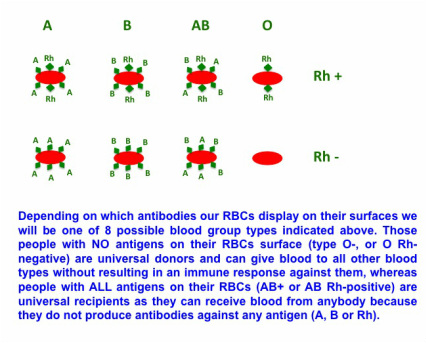
Our blood type is determined by the antigens our RBCs present (A, B, none or both) in combination with the absence or presence of the additional Rh factor. Result: 8 possible different blood types. This is schematically shown in the figure below.
Since I am a geneticist, it is relevant to point out that our blood type is based on genes we carry on our DNA, which are inherited from our parents and encode for these different antigens. This is why, before the era of DNA testing for things such as paternity, one could use blood type as an indication of whether or not a child could or not be the biological descendant of a specific father. This is not as precise (by far!) as DNA testing, but could rule out paternity in certain cases (for example, an AB child of an A mother can not have an O or A father, it would have to be a B or AB type that provided the "B" gene copy for the child) although not show with 100% certainty that the individual is indeed the father, as it is the case of DNA testing.
Throughout history, blood types have been associated with certain personality types, as well as special diets that are supposed to be good for individuals of a given blood type. There is no real scientific evidence to support this, although there are studies showing higher or lower risk for people with specific blood types to suffer from certain diseases or cancers.
So once you know your blood type, meaning you know what antigens your RBCs present, you also know which antibodies your blood could make in the presence of the antigens your RBCs do not present on their surface. This is shown in the figure below.
Throughout history, blood types have been associated with certain personality types, as well as special diets that are supposed to be good for individuals of a given blood type. There is no real scientific evidence to support this, although there are studies showing higher or lower risk for people with specific blood types to suffer from certain diseases or cancers.
So once you know your blood type, meaning you know what antigens your RBCs present, you also know which antibodies your blood could make in the presence of the antigens your RBCs do not present on their surface. This is shown in the figure below.
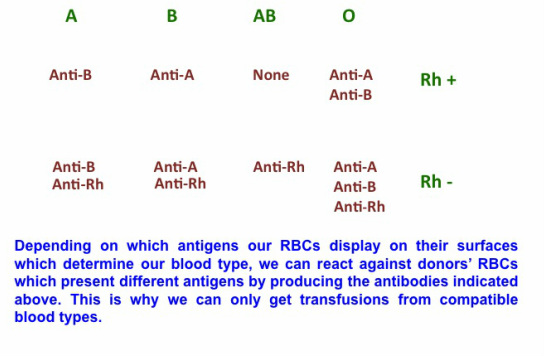
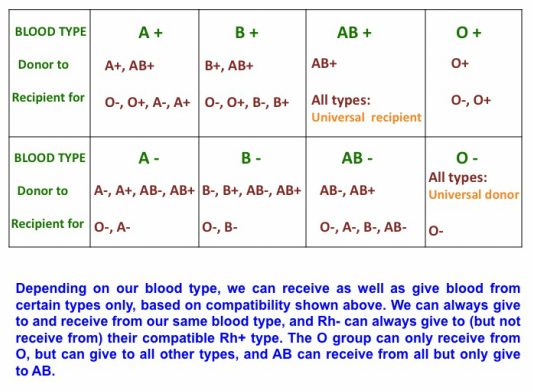
Both the presence of antigens that determine our blood type, and the possible presence of antibodies in the liquid part of our blood (plasma) AGAINST antigens that our RBCs do not have (because they are recognized as foreign substances once they enter your bodies) determine our blood type compatibility, which groups we can donate to and which ones we can receive blood from. In the table below you can find your blood type alongside possible donors and recipients.
I am Rh-negative. For a woman, especially for a pregnant woman, this becomes a worry if the father of the baby is Rh-positive. It is not a big risk for the first baby, but it is for later ones after the mother has been exposed ("sensitized") to the baby's Rh-positive blood during pregnancy and/or delivery. In subsequent pregnancies, these women can develop an anti-Rh immune response against the Rh-positive blood of their fetuses. Her anti-Rh antibodies can cross the placenta to destroy the fetal Rh-positive cells which can result in anemia possibly leading to jaundice, heart failure, or organ enlargement and may require Rh-negative blood transfusions. Many women had stillborn babies after having 1 or 2 healthy babies before the Rh factor was known. Also fatality or very bad adverse reactions occurred when Rh-negative people received blood from Rh-positive donors (again, not the first time, but after being "sensitized").
Nowadays, pregnant Rh-negative women like me are given something called a "RhoGAM" shot at different times during pregnancy (as well as after any procedure that involves risk of exposure to Rh-positive fetal blood such as amniocentesis and also after a miscarriage or any bleeding) and right after delivery if the baby is confirmed to be Rh-positive. This preparation (shot) which is given intramuscularly, can actually prevent the so called "Rhesus disease" or "hemolytic disease of the newborn". RhoGAM is made from donated plasma from Rh-negative people who have been exposed to Rh-positive blood and have therefore produced anti-Rh antibodies (RhoGAM is also called Rh immune globulin) after being sensitized. One such donor is an amazing Australian man who has given blood over 1000 times and is estimated to have saved over two million unborn babies- see him in a 2 min video at:
http://www.youtube.com/watch?v=OMe4WSzmFnQ
The anti-Rh antibodies delivered with the RhoGAM shot will destroy any RBCs containing Rh-positive antigens in the maternal blood and thus prevent any adverse reaction. A shock for me was to find out that every single time I got the RhoGAM shot (which was not cheap!) it was NOT covered by my health insurance, which covered everything else related to pregnancy and delivery. As I live now in Asia, it is good to be aware that Rh-negative blood is very rare (about 1%) among Asians, people of African-American descent and native Americans, whereas it is over 15% for Caucasians and over 20% in particular for for Basque people.
So..... if you still don't know which type your blood is, you better go find out :-)
Nowadays, pregnant Rh-negative women like me are given something called a "RhoGAM" shot at different times during pregnancy (as well as after any procedure that involves risk of exposure to Rh-positive fetal blood such as amniocentesis and also after a miscarriage or any bleeding) and right after delivery if the baby is confirmed to be Rh-positive. This preparation (shot) which is given intramuscularly, can actually prevent the so called "Rhesus disease" or "hemolytic disease of the newborn". RhoGAM is made from donated plasma from Rh-negative people who have been exposed to Rh-positive blood and have therefore produced anti-Rh antibodies (RhoGAM is also called Rh immune globulin) after being sensitized. One such donor is an amazing Australian man who has given blood over 1000 times and is estimated to have saved over two million unborn babies- see him in a 2 min video at:
http://www.youtube.com/watch?v=OMe4WSzmFnQ
The anti-Rh antibodies delivered with the RhoGAM shot will destroy any RBCs containing Rh-positive antigens in the maternal blood and thus prevent any adverse reaction. A shock for me was to find out that every single time I got the RhoGAM shot (which was not cheap!) it was NOT covered by my health insurance, which covered everything else related to pregnancy and delivery. As I live now in Asia, it is good to be aware that Rh-negative blood is very rare (about 1%) among Asians, people of African-American descent and native Americans, whereas it is over 15% for Caucasians and over 20% in particular for for Basque people.
So..... if you still don't know which type your blood is, you better go find out :-)

 RSS Feed