Domestic species, whether plants or animals, have been selected for (or adapted) by us humans, and are not the same as those found in the wild. Many domesticated species of plants and animals are not able to survive without our care.
Plants were first domesticated about 10,000 years ago, when agriculture begun with wheat, barley, lentils, and peas in what was then Mesopotamia, (now the Middle East -Iran, Iraq, Turkey, Kuwait and Syria), with very fertile valley soil between the Tigris and Euphrates rivers. Potatoes in South America and rice in Asia were among the first plants domesticated in those regions for food production. It is not clear when/where exactly olives were domesticated, the earliest was probably about 6000 years ago in the Middle East, spreading West to the Mediterranean and North Africa maybe 4500 years ago. Some plants were not cultivated for food purposes, for example cotton plants were used for their fiber to make cloth, and flowers for decoration.
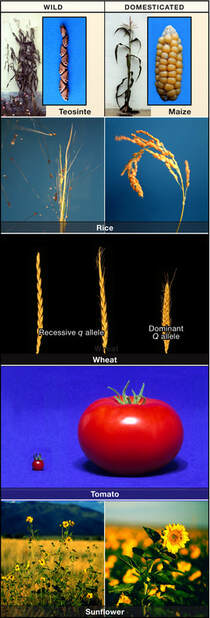
Nowadays in urban settings we are often not familiar with how wild species look like, as we are only exposed to plantations and/or products of domesticates crops. This figure from a review on crop domestication (Cell 2006; 127(7):1309-21) shows striking differences between wild and domesticated species of corn, rice, wheat, tomato and sunflower.
Plants were first domesticated about 10,000 years ago, when agriculture begun with wheat, barley, lentils, and peas in what was then Mesopotamia, (now the Middle East -Iran, Iraq, Turkey, Kuwait and Syria), with very fertile valley soil between the Tigris and Euphrates rivers. Potatoes in South America and rice in Asia were among the first plants domesticated in those regions for food production. It is not clear when/where exactly olives were domesticated, the earliest was probably about 6000 years ago in the Middle East, spreading West to the Mediterranean and North Africa maybe 4500 years ago. Some plants were not cultivated for food purposes, for example cotton plants were used for their fiber to make cloth, and flowers for decoration.
Nowadays in urban settings we are often not familiar with how wild species look like, as we are only exposed to plantations and/or products of domesticates crops. This figure from a review on crop domestication (Cell 2006; 127(7):1309-21) shows striking differences between wild and domesticated species of corn, rice, wheat, tomato and sunflower.
Animal domestication began in Mesopotamia to get meat, milk, and animal skins for clothing and tents. Among the first domesticated animals about 10,000 years ago are the goat and sheep, and chickens in Southeast Asia. It is now believed that animal domestication in most cases was not a single event but, as for pigs, goats, sheep, horses, and chicken, it happened multiple times with domestication events from local populations of wild ancestral species. For example, genetic analyses have shown that ancestors of domestic pigs were found across different regions in Europe, Asia and North Africa and domestication occurred a minimum of six times from local populations- one may have occurred over 13,000 years ago. Larger animals including horses and oxen were domesticated later for plowing and transportation. Cows were easily domesticated because as herbivores that eat vegetation usually available, whereas other herbivores that eat grains such as chicken require domesticated crops such as seeds and grain.
 From: https://www.theatlantic.com/science/archive/2016/06/the-origin-of-dogs/484976/
 The very first species to be domesticated however, which happened before agriculture at a debated time that could have been between 15 and 40 thousand years ago, was the dog, first for hunting help and then as pets. In the first phase of domestication, the dog derived from the grey wolf (Canis lupus), however today domestic dogs are a distinct species (Canis lupus familiaris) and the most variable mammalian species on Earth.
Most dog breeds were established in the last 300-200 years, with strong artificial selection resulting in almost 500 breeds with specific morphology (body size and skull shape, tail shape, fur and pigmentation). Dog breed selection has also worked for specific behaviors such as herding, hunting, guarding, and personality including aggression.
Most dog breeds were established in the last 300-200 years, with strong artificial selection resulting in almost 500 breeds with specific morphology (body size and skull shape, tail shape, fur and pigmentation). Dog breed selection has also worked for specific behaviors such as herding, hunting, guarding, and personality including aggression.
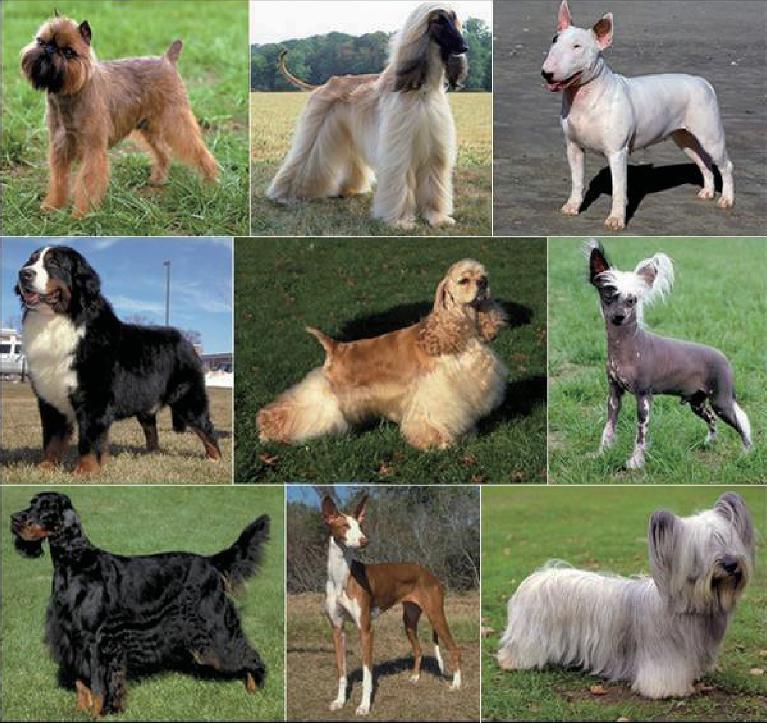
Morphological variation among dog breeds; from upper left and going clockwise: Brussels Griffon, Afghan Hound, Bull Terrier, Chinese Crested Dog, Skye Terrier, Basenji, Gordon Setter and Bernese Mountain dog, and in the center is a Cocker Spaniel. From: Natl Sci Rev. 2019; 6(4): 810–824.
Domesticated plants and animals can look very different from their wild ancestors. For example, domesticated tomatoes seem gigantic compared with their wild ancestors. Something similar occurs in chickens, first domesticated in Asia, with smaller early wild chickens (about two pounds) leading to domestic chickens today weighing as much as 17 pounds and laying many more eggs annually.
Domestication results in genetic changes. We may not be engineering the genetic alteration in the lab (or targeting specific gene/s or using elements from other organisms), but when selecting for taste, shape, color or growth features (faster, pest-resistant, sweeter, etc) we are indeed selecting for specific gene variants and mutations. As in other biology- and medicine-related fields, recent advances in genomics and gene technologies have shed light into aspects of domestication by revealing genome (DNA) sequences of both domesticated species as well as wild ancestors (alive or extinct).
Domestication in plants has led to acquired features such as modified seed size and shattering in cereal species, and modified size and shape in vegetable crops. These modifications have been associated with specific genes in species including tomato, rice, maize, soybean, barley and wheat.
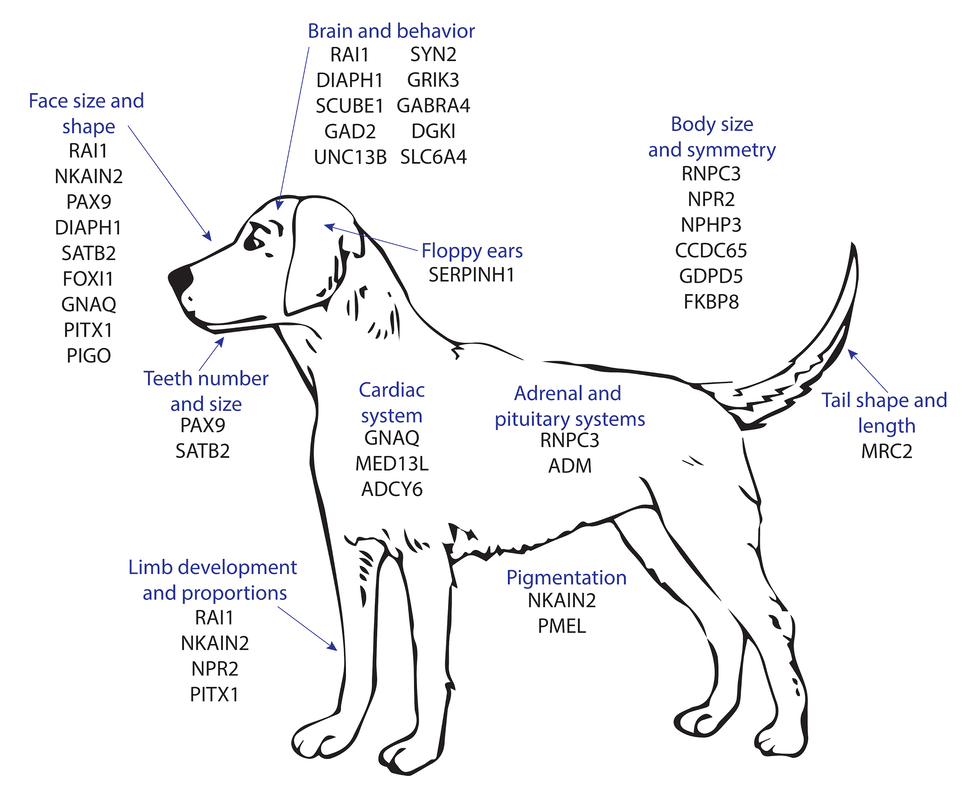
The first genome of a domesticated animal to be fully mapped was that of the chicken, in 2004 (the human genome sequence was completed and available in 2003). Gene sequence comparisons between domesticated and wild animals allow researchers to identify mutations or gene variants that are specific to domesticated animals, sometimes called “domestication genes”. One such gene in chickens is TSHR (thyroid-stimulating hormone receptor), which in wild animals coordinates reproduction with day length, resulting in breeding and egg laying restricted to spring and summer seasons. A TSHR mutation leading to one amino acid change in the receptor protein encoded by the gene in domestic chickens renders the hormone receptor inactive and enables chickens to breed and lay eggs all year long. In pigs, several gene variants/mutations have been reported, based on detailed analysis of genetic variation of local breeds (mostly European), to affect specific phenotypic traits: coat color (KIT, MC1R), production and fatness (LEPR, FTO, MC4R, LEP or MSTN), meat quality (PCK1, PRKAG3, ACACA, CAST, MTTP) and disease resistance (MUC4, GBP5). The figure below shows genes that have been shown to be directly or indirectly linked to phenotypes that distinguish dogs from wolves.
Domestication results in genetic changes. We may not be engineering the genetic alteration in the lab (or targeting specific gene/s or using elements from other organisms), but when selecting for taste, shape, color or growth features (faster, pest-resistant, sweeter, etc) we are indeed selecting for specific gene variants and mutations. As in other biology- and medicine-related fields, recent advances in genomics and gene technologies have shed light into aspects of domestication by revealing genome (DNA) sequences of both domesticated species as well as wild ancestors (alive or extinct).
Domestication in plants has led to acquired features such as modified seed size and shattering in cereal species, and modified size and shape in vegetable crops. These modifications have been associated with specific genes in species including tomato, rice, maize, soybean, barley and wheat.
The first genome of a domesticated animal to be fully mapped was that of the chicken, in 2004 (the human genome sequence was completed and available in 2003). Gene sequence comparisons between domesticated and wild animals allow researchers to identify mutations or gene variants that are specific to domesticated animals, sometimes called “domestication genes”. One such gene in chickens is TSHR (thyroid-stimulating hormone receptor), which in wild animals coordinates reproduction with day length, resulting in breeding and egg laying restricted to spring and summer seasons. A TSHR mutation leading to one amino acid change in the receptor protein encoded by the gene in domestic chickens renders the hormone receptor inactive and enables chickens to breed and lay eggs all year long. In pigs, several gene variants/mutations have been reported, based on detailed analysis of genetic variation of local breeds (mostly European), to affect specific phenotypic traits: coat color (KIT, MC1R), production and fatness (LEPR, FTO, MC4R, LEP or MSTN), meat quality (PCK1, PRKAG3, ACACA, CAST, MTTP) and disease resistance (MUC4, GBP5). The figure below shows genes that have been shown to be directly or indirectly linked to phenotypes that distinguish dogs from wolves.
From: https://blogs.biomedcentral.com/on-biology/2018/06/28/village-dog-dna-reveals-genetic-changes-caused-by-domestication/
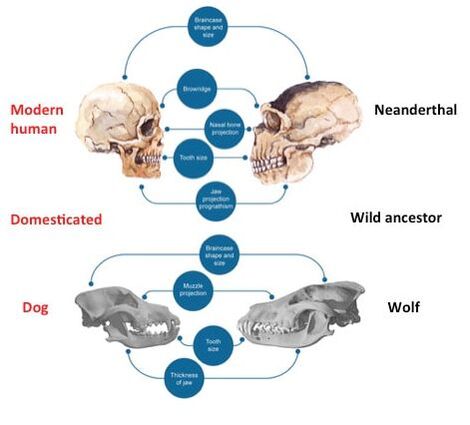
An interesting theory proposes that we humans (and also bonobos) have 'self-domesticated', based on reported domestication traits and genes that are present in domesticated species and not their wild counterparts. A study published in 2017 in PLoS ONE showed that these domestication traits are shared by our species but not found in our Neanderthal or Denisovan wild extinct ancestors. The figure below, from this study, shows a comparison of craniofacial features of us (modern humans) and Neanderthals (top) and dog and wolf (bottom). The left skulls of domesticated species show smaller brow ridges, nasal projections, teeth and cranial capacity; which has been referred to as ‘feminized’ and the product of reduction of androgen levels in parallel with a rise in estrogen levels in domesticated species.

 RSS Feed