As technology advances continuously at exponential speed, especially in fields based on cellular and molecular studies, researchers can go deeper and look more in detail inside organisms, cells, organelles and molecules including DNA, RNA and proteins (see my previous post to learn more about these "levels-of-complexity"). Examples of these breakthroughs are DNA sequencing technologies. These went from scientist being able to sequence specific genes (or gene segments) of interest, investing significant time and resources, to sequencing whole genomes of microorganisms, plants or animals, accomplished sometimes as a result of international collaborations involving different labs and organizations, to the possibility nowadays of having your own personal genome sequenced by a private company to learn about your ancestry and genetic predisposition to some diseases.
Molecular analyses have traditionally involved isolating a sample from an organism or "growing" in the lab, in the appropriate conditions and culture media, a sufficient number of cells to process that provide enough DNA, RNA or protein material for analysis. These experiments, and results used for ("bulk") analysis, are based on populations of cells. This all works well if the goal is to detect molecules (genes (DNA) or RNA transcripts to study gene expression, or proteins or metabolites) that are usually present in most cells with detectable abundance. For rare occurrence events, the target molecules may not be present in enough amount to be detected under these conditions, in which the signal obtained and read is an average of the molecules present in the bulk population, often a heterogeneous mixture of cells in different stages of growth and different genes turned "on" and "off" at the time of sampling. There are methods that allow researchers to "sort" cells or "synchronize" them in order to obtain more homogeneous populations for analysis, these methods still require a minimum amount of the research target molecule present in the population.
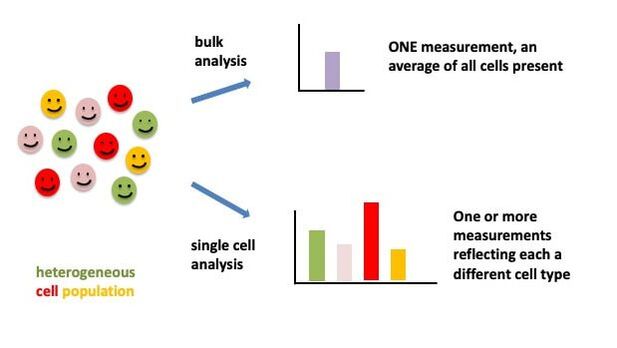
An important breakthrough to address these issues has been the availability, by a variety of technologies, to perform "single cell analysis" of molecules of interest, as opposed to from a cell population. Single cell technologies are used both in research and clinical applications, including for example to study cancer by looking at tumor cells.
Within a tumor, there are different clones of malignant cells which are genetically distinct, sometimes containing different mutations with roles in malignancy. These different clones can differ also in their dividing speed, metastasis capability and sensitivity to cancer treatment. Single cell analysis allows characterization of different subclones, which can inform therapies as well as follow-up of patients' response to treatment and disease progression. Single cell analysis has also been applied to the study of circulating cells that primary and metastatic tumors shed. These circulating cells are obtained from a liquid biopsy (usually a blood sample) and can be used in early diagnosis. With the added advantage that they can be obtained and analyzed in a much less invasive manner than primary and metastatic tumor cells, they allow for more frequent disease and response-to-treatment monitoring.
Single cell analysis of heterogeneous cell samples or tissues
1) Enrichment of target cells if possible
2) Isolation of cells of interest as single cells
3) Amplification of DNA or cDNA from reverse transcription of RNA
(usually PCR-based) to be used in:
4) Sequencing studies
5) Analysis of results
Most single cell analyses are based on sequencing DNA, RNA and epigenetic modifications, for which isolated cells are first broken or "lysed" to release nucleic acids, but protein and other metabolites can also be analyzed, and cells can also be used in assays in which they are kept alive and visualized under the microscope (for more details on epigenetics and labeling/visualization of fluorescent cells under the microscope, see my home page)
Microfluidics technologies, where small amounts of liquids circulate in microchannels are widely used in single cell isolating procedures. In what is known as "droplet microfluidics" (figure below) two unmixable liquid phases (water and oil, for example) flow through microchannels leading to formation of drops of one fluid within the other (carrier) fluid, containing single cells (an aqueous droplet in oil in our example).

These technologies have made it possible to isolate single cells on capture sites such as microchips, which are good platforms to subsequently perform sequencing of DNA or RNA, and have led to "lab-on-chip" devices that act as integrated microsystems. There is a wide variety of microfluidics-based methods for isolation and processing of single cells. In addition to sequencing analyses, they have numerous applications including in cancer research and treatment; stem cells; immunology, microorganism studies and antimicrobial resistance evaluation; therapeutics; development; prenatal screening and personalized medicine.

From “Beatrice the Biologist” (check out her awesome cartoons!)
http://www.beatricebiologist.com/2012/05/single-cell-is-just-fine-thank-you/
http://www.beatricebiologist.com/2012/05/single-cell-is-just-fine-thank-you/

 RSS Feed