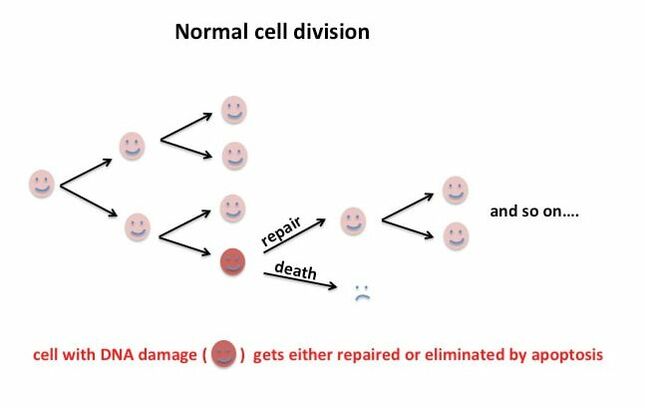
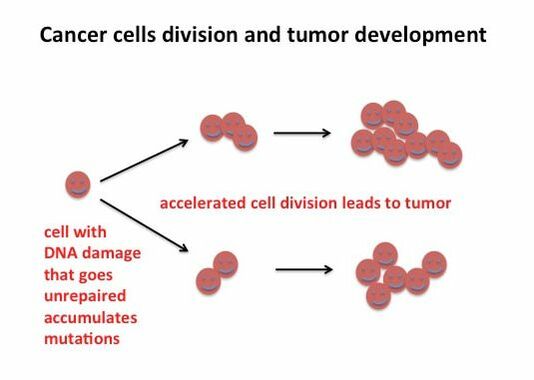
A cancer cell, right before becoming “malignant”, was a normal cell growing inside us, part of a specific tissue, organ, blood cells or bone marrow. The main difference evident in a cancer cell is also where its threat comes from: cell division goes out of control resulting in faster and unchecked cell division leading to tumor growth. Different mutations occur in the cell’s DNA in genes that encode proteins that control and regulate the cell’s life cycle including division and checks and it all goes out of whack. A lot of research is now focused on understanding specific DNA alterations (mutations) that are associated with different types of cancer. Some hereditary mutations are well know to increase our risk to develop certain cancers depending on additional mutations acquired later and additional risk factors we may be exposed to (see my post on genetic testing for disease risk).
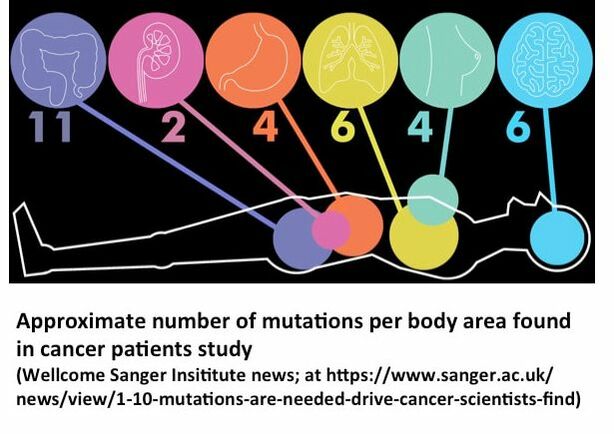
Not just one mutation present will lead to cancer, rather a number of them are accumulated in a cell before transformation occurs. A study published in 2017 in Cell showed that between 1 to 10 mutations are needed depending on the type of cancer (“Universal Patterns of Selection in Cancer and Somatic Tissues”, Martincorena et al); four mutations on average are found in patients with liver cancers, whereas colorectal cancer patients showed an average of 10.
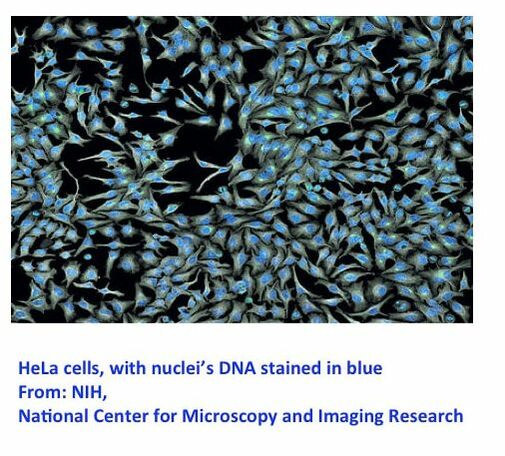
Now a more familiar name to lay audiences thanks to Rebecca Skloot’s book “The Immortal Life of Henrietta Lacks” published in 2010 followed by an HBO movie in 2017, “HeLa” cells have been the most widely used cell line in laboratory research since its discovery in 1951 as the first “immortal” cell line available after it was obtained from treatment of Henrietta Lacks’s cervical cancer by a Johns Hopkins researcher, with the institution making them subsequently free for scientific research. Henrietta died of this cancer in 1951.

The amazing advantage of an immortal cell line, as are those derived from cancers, is that they can divide indefinitely when cultured in the lab, and used for a wide range of purposes including:
Normal cells cultured in the lab will stop dividing after a number of division cycles (40-60) due to shortening of the ends of chromosomes called “telomeres” (see my previous post on telomeres) while HeLa cells have an overactive “telomerase”, an enzyme that lengthens telomeres to keep cells growing for ever. HeLa cells grow unusually fast even compared to other tumor-derived cell lines tested.
- experiments to figure out things about cancer or even non cancer cell lines
- production of cellular reagents for laboratory research including antibodies and other proteins that can be then be used in “cell-free” systems for cellular protein function studies
- production of therapeutic protein pharmaceuticals such as antibodies, hormones and vaccines
- testing potential cancer therapies
Normal cells cultured in the lab will stop dividing after a number of division cycles (40-60) due to shortening of the ends of chromosomes called “telomeres” (see my previous post on telomeres) while HeLa cells have an overactive “telomerase”, an enzyme that lengthens telomeres to keep cells growing for ever. HeLa cells grow unusually fast even compared to other tumor-derived cell lines tested.
The American Type Culture Collection (ATCC), a reference source of all kinds of cell lines and microorganism strains, offers panels of tumor cell lines available by tissue (bladder brain, bone, breast, ovarian, colon, head and neck, leukemia, lymphoma, liver, lung, melanoma, pancreas and stomach cancer cell line panels, some including primary as well as metastatic tumors), each with specific mutations characterized. The molecular geneticist Michael Gottesman at NIH stated how critical these cell lines are in cancer drug development: “There is no cancer drug in current use that was not first tested in a cultured cell model” (Discovery magazine, October 2014).
Normal cells can be engineered to become immortal by infection with a virus such as human papilloma (HPV) which will induce mutations at the DNA level in genes encoding proteins involved in maintaining normal cell division and DNA damage checking and repair.
For more info on interesting novel therapies to treat cancer and testing your genetic risk you can see my previous posts on these topics (genetic testing for disease risk, immunotherapy, and pharmacogenetics).
Normal cells can be engineered to become immortal by infection with a virus such as human papilloma (HPV) which will induce mutations at the DNA level in genes encoding proteins involved in maintaining normal cell division and DNA damage checking and repair.
For more info on interesting novel therapies to treat cancer and testing your genetic risk you can see my previous posts on these topics (genetic testing for disease risk, immunotherapy, and pharmacogenetics).

 RSS Feed