Mitochondria are organelles inside eukaryotic cells (=cells with a nucleus, as opposed to prokaryotic cells like bacteria with no nucleus) which are very cool for many reasons, including: 1) they provide most of the energy the cell needs to function, 2) they are thought to come from a bacteria that entered the cell as a symbiont a loooooong time ago, and 3) they contain their own DNA, separate from the DNA in the nucleus of the cell.
Inside eukaryotic cells there are “organelles”- specialized compartments surrounded by membranes which isolate them from the rest of the cell. One of these organelles is the mitochondrion (see picture below of an eukaryotic cell with its nucleus, containing most of the cell's DNA, and a few mitochondria). Each cell may contain several mitochondria (up to thousands!) in particular those that use a lot of energy, such as brain cells and muscle cells including the heart. Mitochondria are responsible for generating energy in the form of ATP (adenosine triphosphate) by using breakdown products from the food we eat and digest, along with oxygen. This ATP fuels all of the cell’s energy needs, which is why often mitochondria are referred to as the powerhouse of the cell.
Inside eukaryotic cells there are “organelles”- specialized compartments surrounded by membranes which isolate them from the rest of the cell. One of these organelles is the mitochondrion (see picture below of an eukaryotic cell with its nucleus, containing most of the cell's DNA, and a few mitochondria). Each cell may contain several mitochondria (up to thousands!) in particular those that use a lot of energy, such as brain cells and muscle cells including the heart. Mitochondria are responsible for generating energy in the form of ATP (adenosine triphosphate) by using breakdown products from the food we eat and digest, along with oxygen. This ATP fuels all of the cell’s energy needs, which is why often mitochondria are referred to as the powerhouse of the cell.
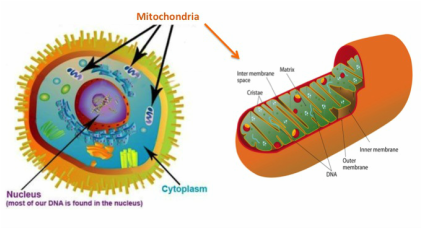
The most accepted theory for the origin of mitochondria is an “endosymbiosis” event between an ancestral eukaryotic cell and a bacterial cell (prokaryotic), a sort of “engulfing” process by which the bacteria (future mitochondrion) was internalized into another cell and then incorporated permanently as an organelle. This postulates a bacterial origin for mitochondria which occurred probably two billion years ago, and was originally proposed by Dr. Lynn Margulis in the 1960s, based on a few similarities between mitochondria and bacteria:
1) Mitochondrial inner proteins such as ribosomes and enzymes, as well as their membranes are also similar to those of bacteria
2) Mitochondria “reproduce” by the same process as bacteria: division in half (“binary fission”) and do so independently from their “host” cell’s division.
3) Mitochondria contain their own DNA, which is circular as bacterial DNA usually is, and passed on to mitochondria progeny when they divide; this DNA is separate from the cell's DNA in the nucleus
This small mitochondrial DNA contains 16,500 base pairs (a tiny fraction compared to over 3 billion pairs of nuclear DNA per cell) with only 37 genes- there are thousands of genes in our nuclei. The DNA within the mitochondria is circular, like bacterial DNA, whereas nuclear DNA is organized in chromosomes (see “karyotype” on my homepage for more details). While each cell contains only two copies of each chromosome in the nucleus, mitochondria contain many copies of their circular DNA, and in addition there are many mitochondria in each cell.
1) Mitochondrial inner proteins such as ribosomes and enzymes, as well as their membranes are also similar to those of bacteria
2) Mitochondria “reproduce” by the same process as bacteria: division in half (“binary fission”) and do so independently from their “host” cell’s division.
3) Mitochondria contain their own DNA, which is circular as bacterial DNA usually is, and passed on to mitochondria progeny when they divide; this DNA is separate from the cell's DNA in the nucleus
This small mitochondrial DNA contains 16,500 base pairs (a tiny fraction compared to over 3 billion pairs of nuclear DNA per cell) with only 37 genes- there are thousands of genes in our nuclei. The DNA within the mitochondria is circular, like bacterial DNA, whereas nuclear DNA is organized in chromosomes (see “karyotype” on my homepage for more details). While each cell contains only two copies of each chromosome in the nucleus, mitochondria contain many copies of their circular DNA, and in addition there are many mitochondria in each cell.
Maternal inheritance of mitochondria and their DNA
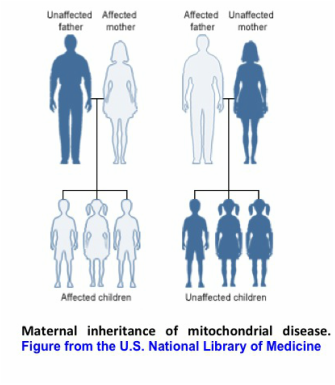
The DNA contained within our chromosomes in the nucleus of the cell comes from both our parents: 23 pairs, 46 chromosomes - half from dad, half from mom. But for mitochondrial DNA, the origin is just maternal, and this is true for most species. The mitochondria from the sperm are broken down shortly after fertilization (the fusion of the human egg and sperm), which means that all the mitochondria and mitochondrial DNA are from the mother. Because of the maternal inheritance of mitochondrial DNA, it is used for tracing ancestry and phylogeny (evolutionary relations between organisms). Family connections can be established even when both of a person's parents are missing, through comparison with maternal relatives, as has been the case to locate families of people who were kidnapped or stolen when they were babies.
The DNA contained within our chromosomes in the nucleus of the cell comes from both our parents: 23 pairs, 46 chromosomes - half from dad, half from mom. But for mitochondrial DNA, the origin is just maternal, and this is true for most species. The mitochondria from the sperm are broken down shortly after fertilization (the fusion of the human egg and sperm), which means that all the mitochondria and mitochondrial DNA are from the mother. Because of the maternal inheritance of mitochondrial DNA, it is used for tracing ancestry and phylogeny (evolutionary relations between organisms). Family connections can be established even when both of a person's parents are missing, through comparison with maternal relatives, as has been the case to locate families of people who were kidnapped or stolen when they were babies.

If you were still thinking these are not good enough reasons to care about our mitochondria, then consider that mitochondrial DNA mutations are an important cause of inherited disease related to mitochondrial function, and are also thought to likely contribute to some common diseases such as diabetes, Alzheimer's and Parkinson's. Mitochondrial DNA disease is passed down from mother to child and currently there is no cure, they are also often very difficult to diagnose. Children born with severe mitochondrial DNA disease are unlikely to survive childhood.
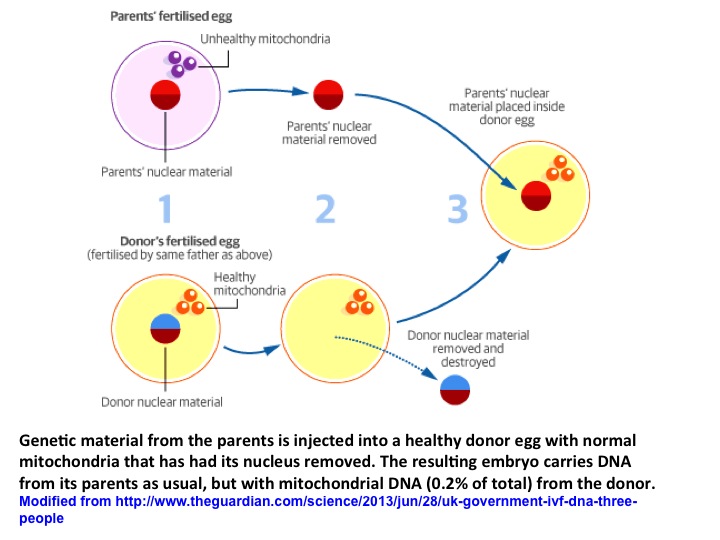
Recently, a new modified version of IVF (see my homepage for IVF (in vitro fertilization) details) to combine the DNA of the two parents affected by mitochondrial disease mutations (in the mother's DNA) with the healthy mitochondria of a donor woman is being discussed and may be soon approved in the UK as an option for a healthy child. The current controversy stems from the "3 parents" view of this approach, which is not genetically correct. Genetically, the nuclear DNA (where the vast majority of genes determining the future individual are) comes from the 2 parents, and only the mitochondrial DNA for the donor - approximately 0.2% only of total cellular DNA. This means that the child will not "look like" the donor as these features are encoded by the nuclear DNA genes.
 RSS Feed