Today the Nobel Prize in Physiology or Medicine was awarded to Yoshinori Ohsumi for his contributions to our knowledge on autophagy mechanisms. Autophagy (“self-eating” from Greek) refers to how cells are able to destroy its own contents which are first compartmentalized by membrane enclosing to form “vesicles”. These are then transported to specialized organelles called lysosomes where they are degraded. Problems in this pathway can lead to diseases including Parkinson’s, cancer and diabetes. The importance of this type of biological process, as well as many others, are often acknowledged by a Nobel prize to their discoverers.
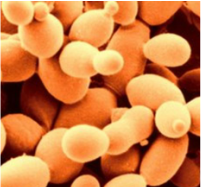
The focus of this post is to recognize that the tool, the organism in which these discoveries were first made, has been in several instances the unicellular eukaryote yeast, most commonly "baker's" yeast or Saccharomyces cerevisiae, used to make bread. They are also known as "budding" yeast as they reproduce by budding daughter cells that emerge from the mother cell, seen in this microscope picture of growing yeast.
I worked many years with yeast cells in graduate school and afterwards. Besides being easy and relatively fast to grow, non-pathogenic and fully sequenced, there are amazing tools that can be used to “label” them to visualize specific organelles or proteins under the microscope. In addition, genetics for eukaryotic cells (with a nucleus with DNA in the form of chromosomes inside, as opposed to prokaryotes such as bacteria which lack nuclei) was first developed and amazingly exploited in yeast. By using genetics mainly manipulating yeast genes (mostly by deleting them or making them defective to a certain degree) researchers can “see” what the effect is of the absence of a particular gene (“mutant phenotype”) – for more on this you can visit my home page. Different genes involved in the same process (such as autophagy) can then be identified. Afterwards, with sequencing and database tools, researchers can try to find “similar” genes in humans for example (or animals used as models of human disease, such as mice- check out my posts on these) and then study these and find, for example, mutations in these genes present in patients with certain diseases in which the specific process may be involved. Or the other way around, a researcher my be interested in a human gene which may be too difficult to manipulate in human cells, so first the gene is altered in yeast to try to obtain information on possible roles in specific processes. During my yeast research years I often collaborated with researchers interested in human genes by making “mutant” yeast cells to study first. Based on results in yeast, these processes are further explored in "higher" eukaryotes (mammals) which involves longer and much more expensive experiments.
These are discoveries that have been awarded a Nobel prize in the 21st century (five total) which were made in the lab using yeast:
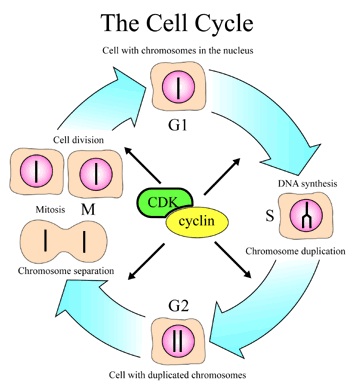
2001 (Leland Hartwell, Paul Nurse and Tim Hunt) Physiology or Medicine: regulation of cell cycle. In the first phase of the cell cycle, called G1, the cell grows. When it has reached a certain size it enters the phase of DNA-synthesis (S) where the chromosomes are duplicated. During the next phase (G2) the cell prepares itself for division. During mitosis (M) the chromosomes are separated and segregated to the daughter cells, which thereby get exactly the same chromosome set up. The cells are then back in G1 and the cell cycle is completed. CDK-molecules and cyclins drive the cell from one phase to the next. The CDK-molecules can be compared with an engine and the cyclins with a gear box controlling whether the engine will run in the idling state or drive the cell forward in the cell cycle (text and figure from Nobel prize press release).
The focus of this post is to recognize that the tool, the organism in which these discoveries were first made, has been in several instances the unicellular eukaryote yeast, most commonly "baker's" yeast or Saccharomyces cerevisiae, used to make bread. They are also known as "budding" yeast as they reproduce by budding daughter cells that emerge from the mother cell, seen in this microscope picture of growing yeast.
I worked many years with yeast cells in graduate school and afterwards. Besides being easy and relatively fast to grow, non-pathogenic and fully sequenced, there are amazing tools that can be used to “label” them to visualize specific organelles or proteins under the microscope. In addition, genetics for eukaryotic cells (with a nucleus with DNA in the form of chromosomes inside, as opposed to prokaryotes such as bacteria which lack nuclei) was first developed and amazingly exploited in yeast. By using genetics mainly manipulating yeast genes (mostly by deleting them or making them defective to a certain degree) researchers can “see” what the effect is of the absence of a particular gene (“mutant phenotype”) – for more on this you can visit my home page. Different genes involved in the same process (such as autophagy) can then be identified. Afterwards, with sequencing and database tools, researchers can try to find “similar” genes in humans for example (or animals used as models of human disease, such as mice- check out my posts on these) and then study these and find, for example, mutations in these genes present in patients with certain diseases in which the specific process may be involved. Or the other way around, a researcher my be interested in a human gene which may be too difficult to manipulate in human cells, so first the gene is altered in yeast to try to obtain information on possible roles in specific processes. During my yeast research years I often collaborated with researchers interested in human genes by making “mutant” yeast cells to study first. Based on results in yeast, these processes are further explored in "higher" eukaryotes (mammals) which involves longer and much more expensive experiments.
These are discoveries that have been awarded a Nobel prize in the 21st century (five total) which were made in the lab using yeast:
2001 (Leland Hartwell, Paul Nurse and Tim Hunt) Physiology or Medicine: regulation of cell cycle. In the first phase of the cell cycle, called G1, the cell grows. When it has reached a certain size it enters the phase of DNA-synthesis (S) where the chromosomes are duplicated. During the next phase (G2) the cell prepares itself for division. During mitosis (M) the chromosomes are separated and segregated to the daughter cells, which thereby get exactly the same chromosome set up. The cells are then back in G1 and the cell cycle is completed. CDK-molecules and cyclins drive the cell from one phase to the next. The CDK-molecules can be compared with an engine and the cyclins with a gear box controlling whether the engine will run in the idling state or drive the cell forward in the cell cycle (text and figure from Nobel prize press release).
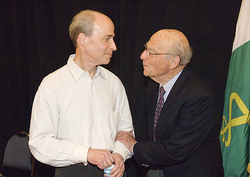
2006 (Roger D. Kornberg) Chemistry: eukaryotic transcription. Kornberg (son of 1959 Nobel prize Arthur Kornberg, both shown in the photograph from Stanford News 2006) helped understand the process of how DNA is converted to RNA (transcription) by a protein complex called “RNA polymerase”; the work involved many years of “crystallizing” different subunits of the complex, bound to the DNA template strand as well as the nascent growing RNA strand being synthesized.
2009 (Elizabeth Blackburn, Carol Greider and Jack Szostak) Physiology or Medicine: telomeres and telomerase (for more info you can check my post on telomeres)
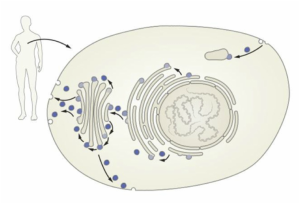
2013 (Randy Schekman, James Rothman and Thomas Südhof) Physiology or Medicine: regulation of vesicle trafficking inside the cell. How intracellular transport inside vesicles is organized and regulated to achieve delivery of substances to where they need to go. Molecules produced in the cell are packaged in vesicles (blue dots, Figure from the Nobel prize org) and precisely transported to destinations within and outside the cell.
2014 (Yoshinori Ohsumi) Physiology or Medicine: autophagy mechanism
2013 (Randy Schekman, James Rothman and Thomas Südhof) Physiology or Medicine: regulation of vesicle trafficking inside the cell. How intracellular transport inside vesicles is organized and regulated to achieve delivery of substances to where they need to go. Molecules produced in the cell are packaged in vesicles (blue dots, Figure from the Nobel prize org) and precisely transported to destinations within and outside the cell.
2014 (Yoshinori Ohsumi) Physiology or Medicine: autophagy mechanism
 RSS Feed