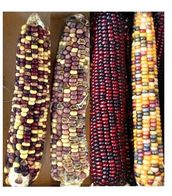
Transposons are one example of an amazing scientific discovery that (as usual, after some time) besides proving useful as tools in scientific and medical research and derived applications, were first found by pursuing research based on simply observing Nature. Barbara McClintock was awarded the Nobel Prize in Physiology or Medicine in 1983 for her earlier discovery in maize of a new type of “mobile” elements in the DNA, the so called transposons. When they inserted in new places inside genes after “jumping around” in the maize genome, they sometimes affected pigment gene expression in cells where the transposition happened, resulting in color variation in corn (maize) kernels.
The importance of these elements in other eukaryotes (plants and animals including us) has become evident in recent decades. Tranposons have been shown to be have played critical roles in genome evolution of many animal and plant species, affecting genome structure and function and also development in organisms where they move around and activate important pathways in the embryo. They are also used as tools in genetic engineering to investigate effects of disrupting genes involved in cellular processes and diseases such as cancer, as well as to deliver gene therapy. As with many successful approaches in medicine recently (see previous posts on CRISPR-CAS9 and immunotherapy) it is the adaptation of an already existing biological mechanism, with a little tweaking, that makes it all possible.
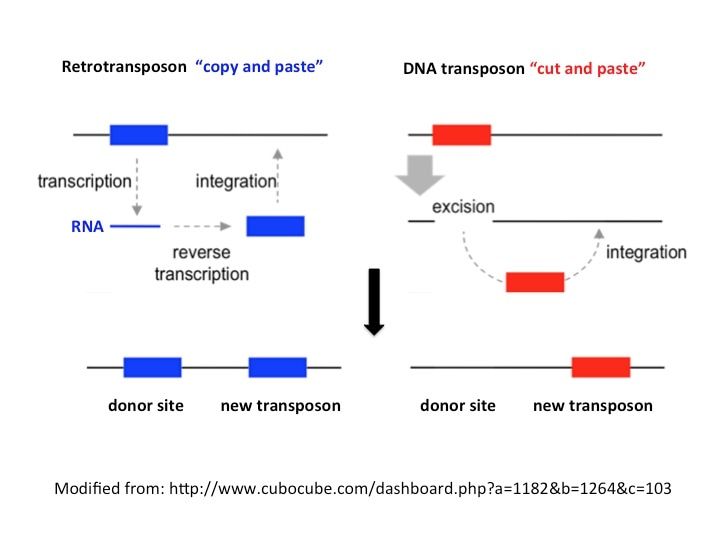
A very abundant type of transposons in our genome are the “retrotransposons” because they move their own DNA around the host’s DNA via an RNA intermediate (using “reverse transcription”). They are also know as “copy-and-paste” transposons, meaning they leave a copy of themselves behind and add a new one elsewhere. Retrotransposons are such a huge chunk of our DNA that they make on average about 40% of all mammalian genomic sequences. They account for most of the “repetitive DNA” found in eukaryotes, which used to be referred to as “junk” or “selfish” DNA when it was thought they had no relevant function and that they focused all their efforts on maintaining themselves in their hosts with no associated benefit for the latter. Another type of transposons that move around by a “cut and paste” mechanism are DNA transposons which comprise about 3% of the human genome.
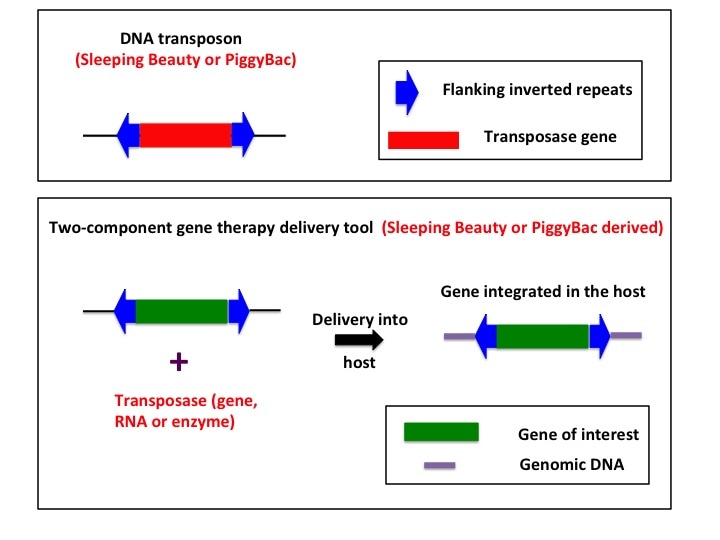
DNA transposons, no longer active in the human genome, have been adapted and are currently under intense development as tools for gene therapy delivery. The main protein needed for the DNA transposon replication/integration process (the enzyme “transposase”) is encoded by a gene in the transposon itself, and this makes it very attractive as a self-sufficient gene delivery tool to be introduced in target cells. The most popular modified transposons to be used as possible carriers of gene constructs for disease and cancer treatment are “Sleeping Beauty” and “PiggyBac”. These DNA transposon-based systems offer certain advantages over the use of viruses as gene delivery tools, such as easier production, lower immunogencity (=lower adverse reaction in the host) and higher "cargo" capacity (can transport bigger pieces of DNA). They have been successfully tested in animal models of human disease such as mice to deliver a therapeutic gene to correct a genetic deficiencies resulting in diseases including hemophilia, Huntington’s, diabetes and others. Sleeping Beauty in particular, due to its fairly random integration profile, has been developed as a toolbox for mutagenesis approaches in organisms or tissues of choice under research, including oncogenesis (cancer development). Variations of the system have been made to offer higher mutagenesis potential, “conditional” expression (allowing to turn the system on and off when needed by using specific stimuli), etc.
Most transposons in human genomes are currently inactive, meaning they are not jumping around actively, as this would cause havoc due to disruption and inactivation of critical genes where they may insert themselves. Transposons can be activated by environmental, developmental or stress factors such as radiation, temperature and infectious agents including viruses and bacteria. Their activation and “jumping” around result in genomic changes in the host. Beneficial changes may be selected through evolution. Whether or not a transposon’s integration at a new site remains depends on selection by the host, as he/she may trigger mechanisms to eliminate harmful integrations and transposons may be eliminated by the immune system.
These little DNA elements at times jumping around in our DNA reflect the real genomic scenario in which there is a dynamic interplay between a variety of factors and our DNA (epigenetics being a major mechanism of regulation of all these processes- see my homepage for details) that results in potential ways of generating changes that may be needed to face environmental or infectious threats, or alternatively, in damaging endogenous alterations as well. Cancer, in itself a stressor, has been shown to result in increased numbers of transposons in tumoral cells of ovarian, prostate, liver, and colon cancers, making them potentially involved with the initial process that led to the cancer (under investigation) and certainly making transposons number increase a “marker” for cancer cells.
These little DNA elements at times jumping around in our DNA reflect the real genomic scenario in which there is a dynamic interplay between a variety of factors and our DNA (epigenetics being a major mechanism of regulation of all these processes- see my homepage for details) that results in potential ways of generating changes that may be needed to face environmental or infectious threats, or alternatively, in damaging endogenous alterations as well. Cancer, in itself a stressor, has been shown to result in increased numbers of transposons in tumoral cells of ovarian, prostate, liver, and colon cancers, making them potentially involved with the initial process that led to the cancer (under investigation) and certainly making transposons number increase a “marker” for cancer cells.

 RSS Feed