Let's look in more detail at what we can do with animal models (we'll focus on the mouse model) to learn about and look for prevention and cure options for humans diseases. This, when done, is usually the pre-clinical step prior to testing a candidate drug in humans in clinical trials. What many people are not aware of is how much research in laboratories has to be conducted PRIOR to having a candidate drug. There might be tests done in "cells in culture" - for example, if we are working with a specific tissue, tissue-specific cells can be grown "in vitro" in the lab and the drug can be added to the growth medium to see what happens to the cells. If it works (if the drug kills the cells that are sick or infected with a virus, bacteria or parasite) some of the next questions are whether this drug can be ingested orally and make it to the target cells, whether it would result in toxicity for any other organs or tissues, what dose needs to be given orally to result in an effective concentration at the target site, and other medically appropriate considerations. Before testing the drug in humans, one can try to get these answers from an animal model where genetics, diet and environmental factors are controlled. Actually, the more research done in animals prior to clinical trials in humans (especially if this research has shown that the drug is safe a effective in the animal model) the faster the trials will be funded and approved to be conducted in humans.
The subject of animal testing has been historically a bit controversial in the view of animal rights activists. Work with animals in academic and private research institutions is highly regulated. Whenever applying for funding for a study using animals as research subjects, researchers have to prove that the numbers proposed are the minimum they need to get a statistically valuable result, and that they will comply with all the approved protocols for care and management of the animals used.
Let's take as an example a mouse model that can be infected with a virus or bacteria that causes disease in a manner that can be monitored (a growth of a tumor, invasion of a tissue that can be dissected to evaluate the degree of infection, visible symptoms). This is the mouse model of the corresponding human disease
The subject of animal testing has been historically a bit controversial in the view of animal rights activists. Work with animals in academic and private research institutions is highly regulated. Whenever applying for funding for a study using animals as research subjects, researchers have to prove that the numbers proposed are the minimum they need to get a statistically valuable result, and that they will comply with all the approved protocols for care and management of the animals used.
Let's take as an example a mouse model that can be infected with a virus or bacteria that causes disease in a manner that can be monitored (a growth of a tumor, invasion of a tissue that can be dissected to evaluate the degree of infection, visible symptoms). This is the mouse model of the corresponding human disease
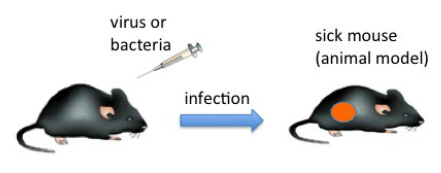
Of course these models are only possible if the infection actually occurs in the mouse, but many more models in the mouse for human diseases are available now because of genetic manipulation that allows for the infection to occur, resulting in what's called "humanized mouse model".
OK, so let's say a lot of research in a laboratory that specializes in studying the particular virus or bacteria of interest has resulted in a candidate gene mutation (if you go to the genetics and mutations section of my home page you can get more information on how this works). This research we are talking about here, let me emphasize, sometimes occurs in an academic setting where graduate students and postdoctoral researchers spend many days (and nights!) running experiments (sometimes again and again....) to learn more about possible genes/proteins to target in the infectious agent. Nowadays, compared to when I was a graduate student in the '90s, there is much more collaboration and communication between academia and private industry (pharmaceuticals) and biotech companies to combine efforts towards this goal. The private sector invests more money and resources in directly finding tools useful in prevention/cure whereas the academic laboratories might be researching at a more "basic" level. However, often the basic research which takes a long time and effort (and is usually not as well funded!) is what provides the basis for a candidate drug that eventually makes it to the market.
As I was saying before the disgression above, let's picture a scenario in which research has led to a candidate target for a drug and let's call this candidate protein Y. Protein Y is the product of the "expression" of the gene y. As I explained in the homepage, the beauty of genetics is that we can ask what the role of protein Y is by "mutating" gene y to result in the absence or a very diminished amount of its product protein Y. We can then use the mouse model to test the hypothesis that this gene/protein is indeed a good target. We infect the mouse with the mutant and ask whether this defective virus or bacteria can still produce the "phenotype" associated with the infection (in the figures, this phenotype is represented by the orange circle which could be a tumor). In the actual experiment, as with all serious ones when we evaluate any of these questions, there rare 2 groups of mice: one of them will be infected with the normal ("wild type") virus or bacteria (the one from the figure above) and will result in the measurable infection, and the second group will be the one infected with the mutant (figure below). This comparison is important because often the effect is not a complete absence of the infection, it might be reduced and then a possible quantification of the reduction of the infection due to the mutant compared to the wild type agent is the result of the experiment.
OK, so let's say a lot of research in a laboratory that specializes in studying the particular virus or bacteria of interest has resulted in a candidate gene mutation (if you go to the genetics and mutations section of my home page you can get more information on how this works). This research we are talking about here, let me emphasize, sometimes occurs in an academic setting where graduate students and postdoctoral researchers spend many days (and nights!) running experiments (sometimes again and again....) to learn more about possible genes/proteins to target in the infectious agent. Nowadays, compared to when I was a graduate student in the '90s, there is much more collaboration and communication between academia and private industry (pharmaceuticals) and biotech companies to combine efforts towards this goal. The private sector invests more money and resources in directly finding tools useful in prevention/cure whereas the academic laboratories might be researching at a more "basic" level. However, often the basic research which takes a long time and effort (and is usually not as well funded!) is what provides the basis for a candidate drug that eventually makes it to the market.
As I was saying before the disgression above, let's picture a scenario in which research has led to a candidate target for a drug and let's call this candidate protein Y. Protein Y is the product of the "expression" of the gene y. As I explained in the homepage, the beauty of genetics is that we can ask what the role of protein Y is by "mutating" gene y to result in the absence or a very diminished amount of its product protein Y. We can then use the mouse model to test the hypothesis that this gene/protein is indeed a good target. We infect the mouse with the mutant and ask whether this defective virus or bacteria can still produce the "phenotype" associated with the infection (in the figures, this phenotype is represented by the orange circle which could be a tumor). In the actual experiment, as with all serious ones when we evaluate any of these questions, there rare 2 groups of mice: one of them will be infected with the normal ("wild type") virus or bacteria (the one from the figure above) and will result in the measurable infection, and the second group will be the one infected with the mutant (figure below). This comparison is important because often the effect is not a complete absence of the infection, it might be reduced and then a possible quantification of the reduction of the infection due to the mutant compared to the wild type agent is the result of the experiment.
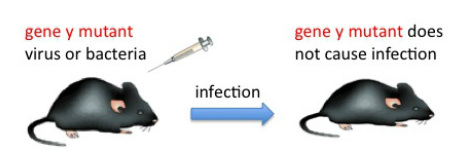
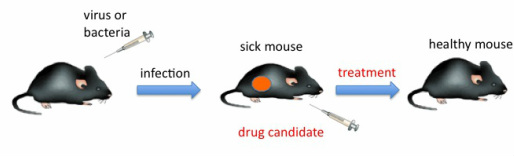
The next step will be to test in the lab, usually without involving animals at this point (either with the purified protein in a biochemistry assay, or in cultures of the growing virus or bacteria) possible drugs that will result in inactivation of protein Y. Once an inhibitory drug is confirmed to work well "in vitro" in the test tube assay or in cultures, it can then be tested in the mouse model to see if it results in protection against the infection.
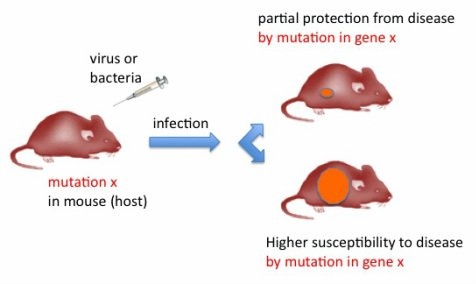
And the last piece on animal models for today brings another important point on human pathogens research: we can study the infectious agent on one side, and what happens in the "host" on the other side, all resulting in valuable information about the mechanism of the infectious disease. Sometimes certain populations or families are more susceptible (or resistant) to a disease. Scientists can look at possible mutations associated with this trait in people (patients), engineer similar mutations in the mouse (in what is called a "homolog" gene, meaning the equivalent gene in mouse for the human gene that is affected in the human patients) and then look at whether they confer protection or higher susceptibility to infection in the mouse model compared to the non-mutant host (mouse).
Of course a mouse is a mouse, and all the drug trials must be done in human populations in a highly regulated manner to prove safety and efficacy, but animal testing can be helpful in choosing the best candidate drug (most effective, least toxic) as well as a possible dose. Testing in animals can also lead to some drug candidates being ruled out due to toxicity concerns before they ever make it into humans.

 RSS Feed