If you have a hormonal problem, you have probably been treated by an endocrinologist. Hormones, which are substances produced by different organs called “endocrine glands” in our bodies, are secreted into our blood and act as messengers once they reach cells in target organs that have “receptors” for a particular hormone, and this in turn results in a particular effect. The action of hormones controls many delicate processes inside our bodies, ranging from metabolism, growth and development to reproductive cycles in women, behavior and immune system regulation.
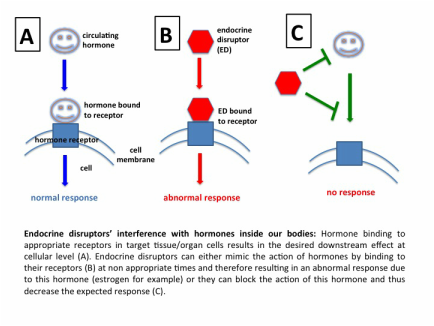
Endocrine disruptors are chemicals that enter our body and can act as (mimic) a hormone, or interfere with/block its action, resulting in a change from what our own hormones would do (see figure below) which could affect our bodies and emotions. There is an ever growing number of examples of these disruptors now known to affect us, and possibly many more that we have not yet characterized. Some are natural, but many are man-made and used by us in ways that deliver them into our bodies. Exposure occurs by ingestion of food and water, inhalation of gases and particles, and through skin contact. These compounds are widespread and include drugs, pesticides such as DDT, chemicals used in the plastics industry, flame retardants, household cleaning products, cosmetic products (soaps, shampoos, creams, nail polish, etc), industrial by-products and pollutants, and fuels. Perfluorinated compounds (PFCs) found in water resistant clothes and non-stick frying pans (teflon-covered) are also believed to be endocrine disruptors,
Endocrine disruptors are chemicals that enter our body and can act as (mimic) a hormone, or interfere with/block its action, resulting in a change from what our own hormones would do (see figure below) which could affect our bodies and emotions. There is an ever growing number of examples of these disruptors now known to affect us, and possibly many more that we have not yet characterized. Some are natural, but many are man-made and used by us in ways that deliver them into our bodies. Exposure occurs by ingestion of food and water, inhalation of gases and particles, and through skin contact. These compounds are widespread and include drugs, pesticides such as DDT, chemicals used in the plastics industry, flame retardants, household cleaning products, cosmetic products (soaps, shampoos, creams, nail polish, etc), industrial by-products and pollutants, and fuels. Perfluorinated compounds (PFCs) found in water resistant clothes and non-stick frying pans (teflon-covered) are also believed to be endocrine disruptors,
Some well studied endocrine disruptors are the so called xenoestrogens, which can have estrogenic effects (they mimic the action of the hormone estrogen in our bodies). Xenoestrogens from plants, phytoestrogens, are mainly isoflavones (genistein and daidzein) which are present in soy and some legumes, fruits, and nuts. Other xenoestrogens such as phthalates can last a long time in the environment and affect wildlife and humans. Polychlorinated biphenyls (PCBs) now banned but still in the environment, accumulate in the food chain and can be estrogenic or antiestrogenic. PCBs are believed to cause swelling of the thyroid and result in reproductive problems in fish in the Great Lakes ... yes, not only us but wildlife also- we are all under the influence of endocrine disruptors present in the air, water and food. Once they enter our bodies, even in very small concentrations, they can disrupt the action of hormones and hormone pathways ("gene expression" of hormones, enzymes involved in making hormones, hormone receptors, etc) and cause abnormal functioning. Some endocrine disruptors have very long lives and not biodegradable, meaning that even after they are banned or no longer used they can persist in the environment. Some naturally occurring chemicals that disrupt hormones are arsenic, mercury and lead.
The synthetic estrogen diethylstilbestrol (DES) was prescribed to pregnant women over 50 years ago to prevent miscarriages, and although it was not effective in doing so, in the early 1970s doctors reported vaginal cancers, reproductive defects (uterus and ovaries) and immune system suppression in young women that were later linked to their mothers having used DES.
The synthetic estrogen diethylstilbestrol (DES) was prescribed to pregnant women over 50 years ago to prevent miscarriages, and although it was not effective in doing so, in the early 1970s doctors reported vaginal cancers, reproductive defects (uterus and ovaries) and immune system suppression in young women that were later linked to their mothers having used DES.
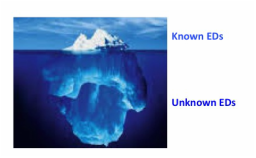
In a WHO/UNEP state of the science report on endocrine disrupting chemicals published in 2012, a key concern is stated as follows: “ Close to 800 chemicals are known or suspected to be capable of interfering with hormone receptors, hormone synthesis or hormone conversion. However, only a small fraction of these chemicals have been investigated in tests capable of identifying overt endocrine effects in intact organisms.” So what we know today as proven and possible dangerous endocrine disruptors may just be the “tip of the iceberg”…
When my daughter was a baby I first heard about BPA (bisphenol A), an endocrine disruptor which was banned in Canada and Europe for baby bottles but still legal in the US (it was banned by the FDA in 2012). BPA is present in plastics, food and beverage cans, sports equipment, medical and dental devices, and certain paper such as receipts and tickets. It leaks into your food or beverage from the container where it is present, especially if the food/beverage is hot. I decided then to use glass bottles (very hard to find!) for my daughter’s milk after breastfeeding. There are now BPA-free bottles and other products available, but the new compounds used instead of BPA may act similarly, as some of them are from the same family/chemical structure. We also need to keep in mind that there is now evidence, especially in animal models, that maternal and fetal exposure to endocrine disruptors could play a huge role in many endocrine diseases, as hormonal action during embryonic and fetal development as well as postnatal effects that result in specific structures to develop or not, will have effects lasting a lifetime. Development of the nervous system and reproductive organs can be severely affected at very early stages by endocrine disruptors.
So what to do? As with other issues like global warming for example, while we wait for tighter regulation, research and monitoring at country/region level, all we can do is be aware and informed (and educate others!) and try to avoid exposure as much as possible - especially in pregnancy and children. Avoid plastics, non-stick cookware and pesticides, eat organic, and spread the word.
So what to do? As with other issues like global warming for example, while we wait for tighter regulation, research and monitoring at country/region level, all we can do is be aware and informed (and educate others!) and try to avoid exposure as much as possible - especially in pregnancy and children. Avoid plastics, non-stick cookware and pesticides, eat organic, and spread the word.

 RSS Feed