Bacteria have colonized pretty much all habitats on Earth including the bottom of the sea, volcanoes, the Everest, and inside our bodies (see my microbiome post) to account for about half of all cells in each of us. We keep discovering amazing abilities bacteria have, which have led to and are currently the focus of numerous studies resulting in important real and potential medical and environmental applications.
In order to thrive in different environments, bacteria use specific mechanisms based on available resources. A group that has received special attention in recent years is one that uses/generates electricity.
When we say we breathe oxygen, what we really mean mechanistically is that we use oxygen as an electron acceptor of the energy-generating process (see my posts on mitochondria and ATP) essential to our lives. This chain of biochemical reactions starts with food metabolism where carbohydrates/sugars we eat provide the electrons that are then passed around different “electron carriers” to be finally delivered to oxygen. In low- or no-oxygen environments, bacteria have the ability to use other elements as electron acceptors including iron, manganese and other metals (in oxide form), with the first metal-reducing bacteria reported in the 1980s, Shewanella and Geobacter. More recently (in 2005) Geobacter bacteria were reported to have what are now known as “bacterial nanowires”, based on the ability of their long pili or extracellular protein nanofilaments to conduct electricity. This is different from our cells in that the electron transfer is “extra-cellular” as it happens outside of the bacterial cell. The current model is one of “electron hopping” along bacterial nanowires. One Geobacter species has been shown to produce nanowires of up to 20 μm in length, which is about 20-fold longer than Geobacter cells. Individual fibers have the charge transport capacity to discharge respiratory electrons at μm distances from the cell at ∼1 billion electrons per second.
In order to thrive in different environments, bacteria use specific mechanisms based on available resources. A group that has received special attention in recent years is one that uses/generates electricity.
When we say we breathe oxygen, what we really mean mechanistically is that we use oxygen as an electron acceptor of the energy-generating process (see my posts on mitochondria and ATP) essential to our lives. This chain of biochemical reactions starts with food metabolism where carbohydrates/sugars we eat provide the electrons that are then passed around different “electron carriers” to be finally delivered to oxygen. In low- or no-oxygen environments, bacteria have the ability to use other elements as electron acceptors including iron, manganese and other metals (in oxide form), with the first metal-reducing bacteria reported in the 1980s, Shewanella and Geobacter. More recently (in 2005) Geobacter bacteria were reported to have what are now known as “bacterial nanowires”, based on the ability of their long pili or extracellular protein nanofilaments to conduct electricity. This is different from our cells in that the electron transfer is “extra-cellular” as it happens outside of the bacterial cell. The current model is one of “electron hopping” along bacterial nanowires. One Geobacter species has been shown to produce nanowires of up to 20 μm in length, which is about 20-fold longer than Geobacter cells. Individual fibers have the charge transport capacity to discharge respiratory electrons at μm distances from the cell at ∼1 billion electrons per second.
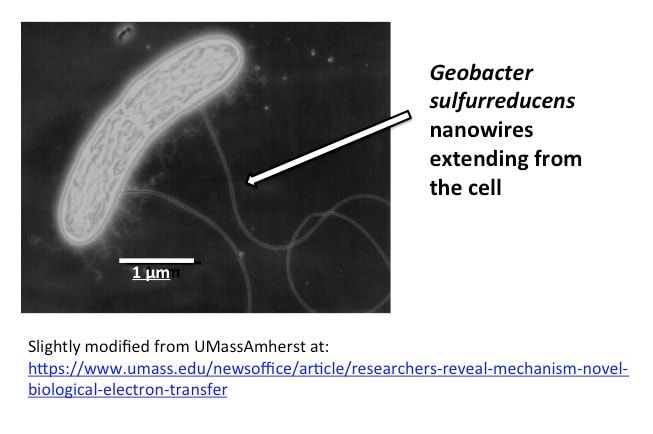
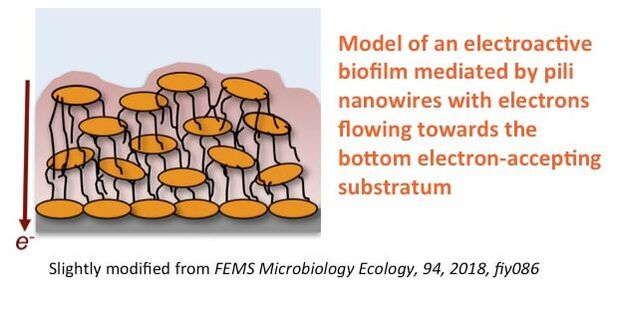
These bacterial nanowires allow bacteria to live on iron and other metals abundant in habitats such as soil and marine and freshwater water sediment. Some bacteria that grow in communities known as “biofilms” (see my biofilms post) have been shown to colonize microelectrode surfaces, leading to electroconductive biofilms forming a redox gradient by transport from electron-rich to electron-poor areas. Depending on the type of bacteria they donate to or receive electrons from electrodes: anodes accept electrons from biofilm bacteria that grow on them, while cathodes grow electrotrophic bacteria that consume their electrons.
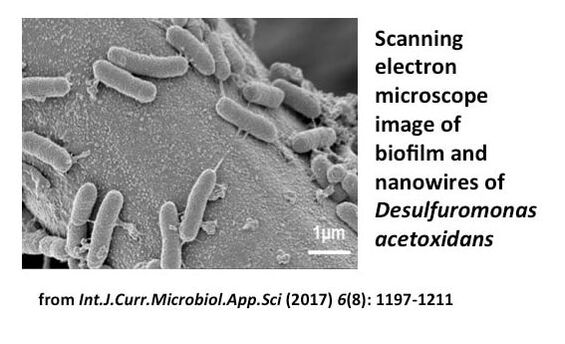
These biofilms can even grow as a combination of two different Geobacter or other species. The pili that act as nanowires play a role in the formation of these multicellular biofilm structures by mediating cell aggregation.
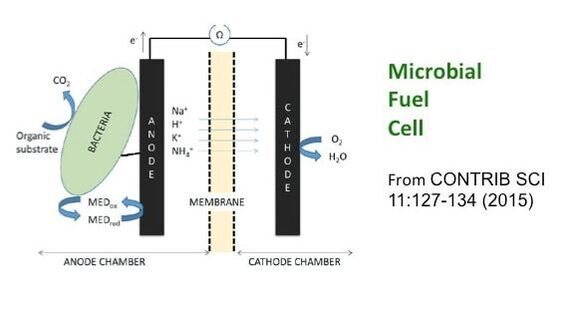
Electricity from bacteria and biofilms harnessed with electrodes is now the focus of potential applications such as bioremediation (soil and water contaminants including toxic heavy metals and radioactive waste, which are chemically reduced to non-toxic forms: uranium form underwater for example) and electricity harvesting or bioenergy with the use of “microbial fuel cells” (MFCs). These MFCs use microbial cellular respiration to pass electrons from the anode to the cathode separated by an ion exchange membrane, with organic “fuel” fed into the anode chamber (wastewater for example), which bacteria as a biofilm growing on the anode oxidize and reduce. Protons, electrons, and carbon dioxide are produced as byproducts, with the anode serving as the electron acceptor in the bacteria’s electron transport chain. Bacteria here are acting as "biocatalysts" in the generation of electricity from organic matter or waste.

 RSS Feed